 |
|
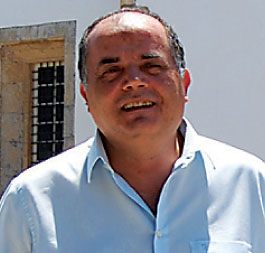
Goncalo Amaral, |
In an interview staged only a
short walk from the regional PJ police headquarters
in Faro over the weekend, Goncalo Amaral, the former
leading detective in the case involving the
disappearance of Madeleine McCann, has an open and
frank conversation with The Portugal News. Lambasted
by the British media, and ignored by much of the
Portuguese written press since the launch of his
controversial book last week (which the Correia da
Manh?newspaper has assisted in promoting), Goncalo
Amaral explains his reasoning behind certain methods
of investigation, and stresses his actions to date
have not been to accuse anyone, rather, he argues,
his focus has been about the pursuit of truth.
The Portugal News:
Did you leak information about the investigation to
the media?
Gon?lo Amaral: I never had anything to do with
leaks. We have to look at from where these leaks
could have originated. A number of entities worked
with us during the investigations and we cannot rule
out the possibility that some of these leaks
originated in Britain. As a matter of fact, when the
FSS handed over their report to Portuguese police,
we kept it under wraps, but a British daily was the
first to appear with extracts of the FSS's findings.
TPN: But how does that explain that some sections of
the Portuguese press have printed confidential
information that later proved to be accurate?
GA: Perhaps they had good sources of information,
but we cannot conclude that they were given
information by police in the Algarve.
TPN: The report leaked last week says that Gerry and
Kate were made arguidos on the ?merest possibility?
that they were involved in the disappearance of
their child. Is that accurate?
GA: They were made arguidos on suspicion of two
crimes: concealing a body and simulating an
abduction and potentially the crime of abandonment.
But saying they were made arguidos on the merest
possibility that they were involved in the
disappearance of their child is not true. The
conclusions reached by the team investigating the
crime, including colleagues in Britain, are the same
as the five points I mention at the end of my book.
Perhaps the conclusions reached in this latest
report were made to facilitate the archiving of the
case and findings were put across in a mild manner.
Once you gain access to the case files, you will
find that it was not due to a mere possibility.
TPN: What do we know about Madeleine's
disappearance?
She was here on holiday. There is obviously no doubt
that Madeleine existed. There is also no doubt that
she went missing. The scheme employed to visit the
children does, to a large extent, not correspond
with the truth, it was probably used to safeguard
the view that the children were safe [in the
apartments on their own as their parents dined at
the Tapas restaurant].
TPN: How often were the children checked upon?
GA: One of the first lines of the investigation was
to interview the party that was on holiday with the
McCanns to establish this.
TPN: What did you find at the apartment?
No
signs of forced entry. There were no signs of glove
marks on the window. We compiled a report of the
evidence we collected, but we are not here to accuse
anyone.
TPN: Do you think more could have been done before
archiving or closing the case?
GA: In my opinion, a number of things are still
lacking: We should have continued investigating the
parents in order to either charge them or rule them
out as suspects. If I represented this couple, I
would have insisted that police investigations
continue. Not everything we do is to incriminate a
suspect. Often a phone will be tapped in order to
obtain information that will clear a suspect.
We
worked long hours discussing a number of potential
explanations for Madeleine's disappearance; we did
not insist solely that she had been abducted.
TPN: You say that politics prevented you from doing
certain things during the investigation. What were
those actions you would like to have taken?
GA: I found the intervention of the [then] British
Ambassador strange, as besides the British Consul in
Portim? already being involved in the case from the
first morning of Madeleine's disappearance, all
diplomatic channels had been opened and were
functional. With the arrival of the Ambassador, my
colleagues and I thought it was odd, and to a
certain extent made us feel limited in our
investigations.
TPN: Did you ever receive orders to investigate in a
certain manner?
GA: No we did not receive any orders. I don't
like talking about orders. But we felt limited.
TPN: Did the police offer a plea bargain to Kate
McCann?
GA: No.
TPN: But did you not suggest she consider a plea
bargain?
GA: We only explained the nature of certain
crimes. Her lawyer was there, you can ask him.
TPN: Did Kate and Gerry McCann answer all the
questions that you posed to them as fully as
possible?
GA: Up until being declared an arguido, Kate, at the
request of her lawyer, co-operated. When questions
became of a nature that could incriminate her, she
was made an arguido, her rights and duties were read
out to her in English and thereafter she opted for
the right to remain silent.
TPN: And Gerry McCann?
GA: He answered all questions, before and after
being made an arguido.
TPN: When did the police first learn of the
intention of the McCanns to leave Portugal?
GA: With the arrival of the sniffer dogs, I think
back in August, the couple started showing a
keenness to leave the country. As for these dogs, I
have not seen or heard any scepticism in Britain,
contrary to Portugal.
TPN: How can you explain the theory that Kate and
Gerry used their hire car in the disappearance of
their daughter when it was hired 25 days after she
vanished?
GA: I don't know. I was not the one who hired the
car.
A
bodily fluid was detected in the trunk of the car
which was similar to that of Madeleine McCann in 15
of the 19 indicators of her profile.
TPN: Has this evidence been investigated further?
GA: No.
TPN: Why not?
GA: You will have to ask my former colleagues that
question.
TPN: What evidence was there that someone had been
watching apartment 5A prior to Madeleine?s
disappearance?
GA: We spoke to a number of people who came forward.
TPN: Anyone suspicious mentioned in these
statements?
GA: No. Perhaps just a British musician we later
tracked down.
But in a reconstruction, witness testimonies, such
as that of Jane Tanner and others, including
restaurant workers, could be clarified further.
TPN: At what stage did you become suspicious of the
McCanns and why?
GA: There were a number of inconsistencies detected
during the first interrogations.
TPN: Such as?
GA: We were initially told by the parents that when
they checked on the children they would use the
front door. But Kate later said they used the other
door. Because had they used the front door, they
would have detected someone had forced their way
into the room [where Madeleine and the twins had
been sleeping].
But during these initial rounds of questioning, my
team and I believed these inconsistencies were due
to the McCanns and their friends trying to cover the
fact they had left their children unattended, along
with their possible lack of trust in the Portuguese
police. This had a lot of weight for me in the
beginning, especially as the law in Britain is far
tougher concerning the abandoning of children.
TPN: Did you look into sex offenders, and what was
the outcome?
GA: It is very difficult that a paedophile
pre-selected Madeleine. It had to be very well
planned. But all known sexual predators were
investigated.
TPN: Did you have any evidence that Robert Murat and
the McCanns or their friends knew each other
previous to Madeleines disappearance?
GA: We tried to confirm this, but along with the
assistance of the British police, we were unable to
establish any connection. But we looked into all
possibilities. Robert Murat purchased a last-minute
ticket to come to Portugal a couple of days before
Madeleine went missing, perhaps as it was cheaper to
do so. But we had to investigate whether or not his
visit coincided with Madeleines disappearance a
couple of days later and whether he had been
contacted to come here.
TPN: How do you see the lawsuit that you might face
over your book?
GA: My book is based on facts. It could be a good
occasion to take all the case files to court and
compare what I wrote with that which is contained in
the files.
TPN: What next lies ahead for you?
GA: I have had a number of proposals, but in October
I am intending on starting my practical training as
a lawyer, as I already have a law degree, but never
practised.
Brendan de Beer
Edition: 970 |