|
Lisbon
Appeals Court Ruling 19 Oct 2010 |
|
WITH THANKS TO ASTRO FOR TRANSLATION |
|
 |
|
|
This is the English
translation of the full text of the
Appellate Court decision that recently
overturned the ban on Dr. Goncalo Amaral's book,
"Maddie - A Verdade da Mentira", which has been
commonly known to English-speaking people as "Maddie
- The Truth of The Lie".
The translation is ours, and you will understand
that it is still a work in progress, although the
relevant part, that is to say the decision itself
and the reasoning that supports said decision, are
now complete. This text will be updated and
concluded as soon as possible. Thank you for your
understanding.
The ruling is divided into three parts, with several
sub-contents:
I.
Report; it
contains a summary of the court case so far, with
the previous ruling, and the citation of the
contents of each defendant's appeal.
II.
Legal basis and
Reasons; a presentation of proved facts, a brief
explanation and comment concerning the purpose and
enforcement of injunctions in general, and in this
case in particular, followed by the arguments and
the reasoning that lead the judges to the final
decision.
III.
Decision; the
Appellate Court Judge's decision.
Thank you for your
support; special thanks go out to Caroline and Pia,
Ines and others who have/are reviewed/ing the text.
astr |
|
|
|
|
PORTUGUESE COURT PAGE 01 TO 10 |
Unspecified Injunction
Process number 6000/09.8TVLSB-A.L 1
Lisbon Appellate Court Decision
Appeal Review
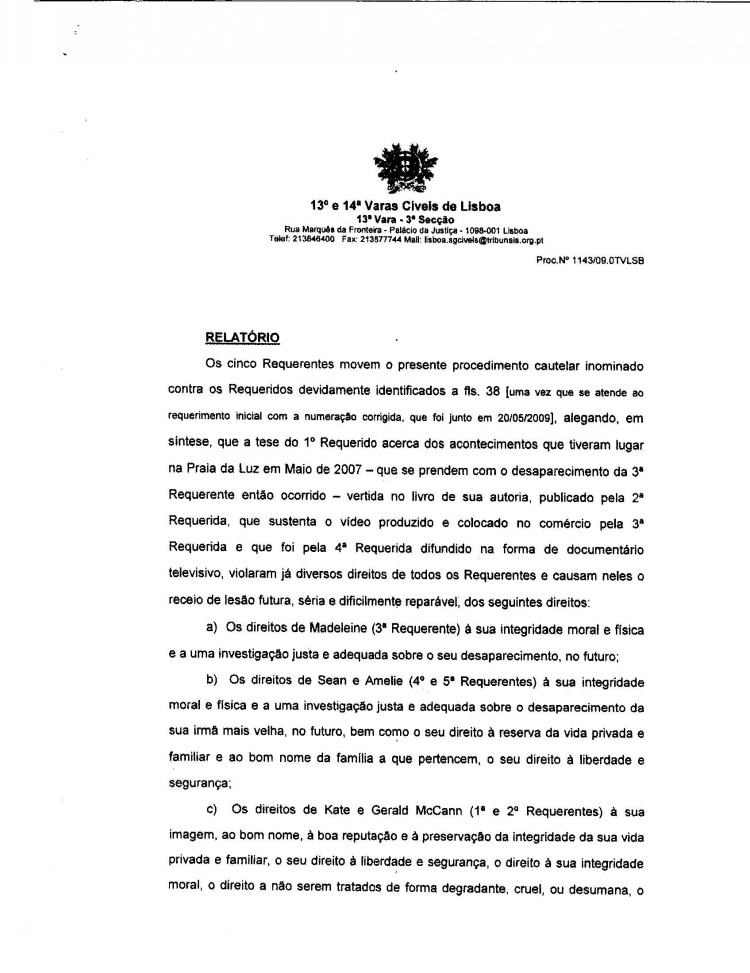
I - Report
At the judicial circuit of Lisbon
Kate Marie Healey McCann,
Gerald Patrick McCann,
Madeleine Beth McCann,
Sean Michael McCann and
Amelie Eve McCann
Have filed an unspecified injunction against:
Goncalo de Sousa Amaral,
Guerra e Paz, Editores, SA
VC - Valentim de Carvalho - Filmes, Audiovisuais, SA and
TVI - Televisao Independente, SA
Alleging that the first two applicants are the Mother and Father of the other applicants, who are all underage, being that it is commonly known that little Madeleine disappeared on the 3rd of May, 2007, and her disappearance prompted an extensive police investigation.
The defendant, Goncalo Amaral, was one of the Judiciary Police (PJ) investigators that was involved in the investigation and later on wrote a book that is titled "Maddie The Truth of the Lie", in which he defends, inter alia
|
|
|
that there is a serious possibility that little
Maddie accidentally died in the apartment where she
was staying and that her parents did, in some
manner, undertake the concealment of her cadaver.
They conclude by requesting:
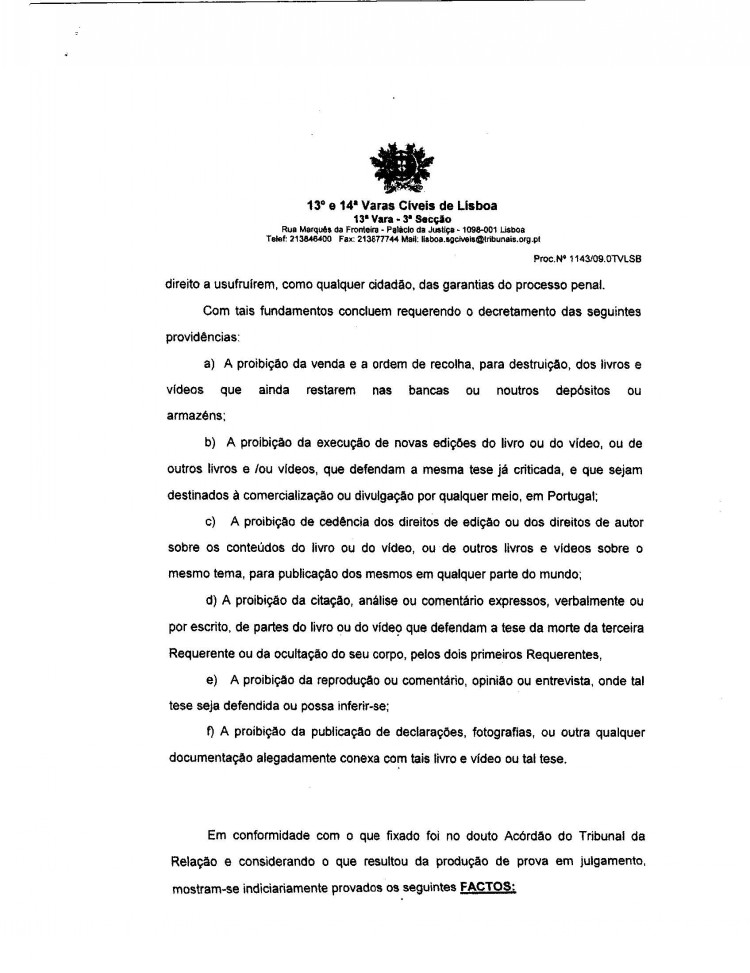
1. The prohibition of
sale and the order to collect, for destruction, all
the books and videos that are still left at points
of sale or other deposits or warehouses;
2. The
prohibition to perform any new editions of the book
or the video, or of any other books and/or videos
that defend the same already criticised thesis, and
that are destined to be sold or made public by any
other means, in Portugal;
3. The prohibition to cede
the editorial or author rights of the contents of
the book or the video, or of any other books and
videos about the same theme, for publication
anywhere in the world;
4. The prohibition to
expressly cite, analyse or comment, verbally or in
writing, any parts of the book or the video that
defend the thesis of death of the third Applicant or
of the concealment of her body, by the first two
Applicants;
5. The prohibition to reproduce any
comment, opinion or interview in which that thesis
is defended or can be inferred;
6. The prohibition
to publish statements, photographs, or any other
documentation that is allegedly connected to said
book and video or said thesis.
The petition was
fully refused as it was understood that the perils
of damage had already been consummated.
In an
appeal, that decision was revoked by a decision of
this Appeals Court, and the production of evidence
was demanded.
After evidence was produced before the
lower court, a new sentence was issued, which
sustained the injunction and decided as follows:
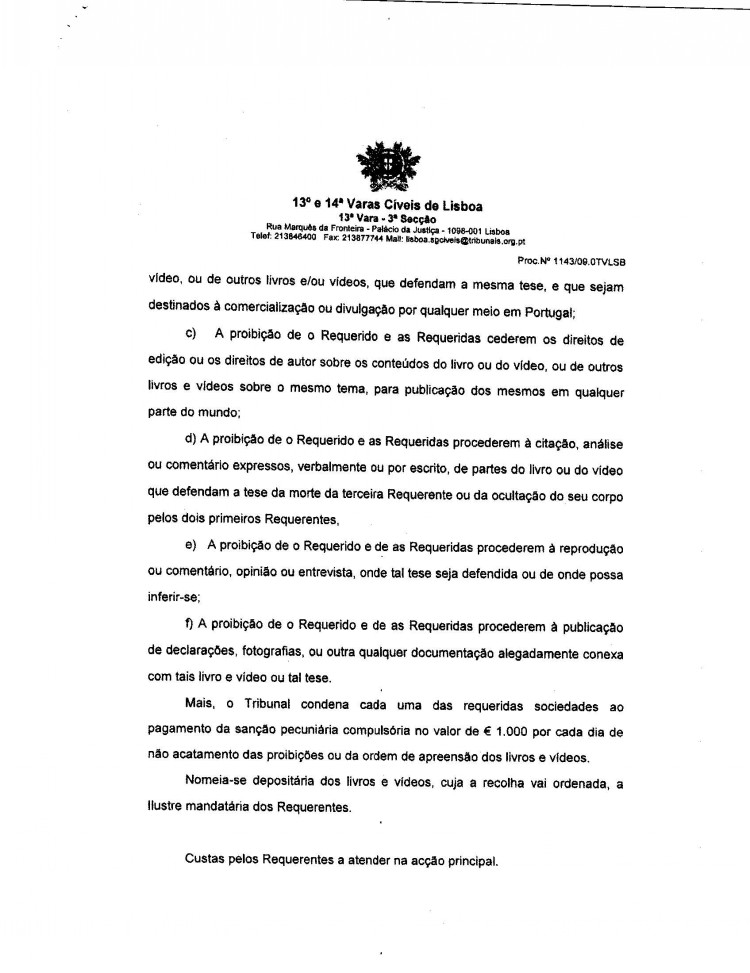
a)
The prohibition for the defendants to sell the books
and videos that were still available at points of
sale or at other deposits or warehouses and the
obligation for the defendants to collect them and to
deliver them to the depositary that is nominated
below; b) The prohibition for the defendants to
perform any new editions of the book or the video,
or of any other books and/or videos that defend the
same thesis, and that are destined to be sold or
made public by any other means in Portugal;
c) The prohibition for the Defendants to cede the
editorial or authorial rights over the contents of
the book or the video, or of any other books and
videos about the same theme, for publication
anywhere in the world;
d) The prohibition for the Defendants to expressly
cite, analyse or comment, verbally or in writing,
any parts of the book or the video that defend the
thesis of death of the third Applicant or of the
concealment of her body, by the first two
Applicants;
|
|
|
e) The prohibition for the Defendants to reproduce any comment, opinion or interview in which that thesis is defended or can be inferred;
f) The prohibition for the Defendants to publish statements, photographs, or any other documentation that is allegedly connected to said book and video or said thesis.
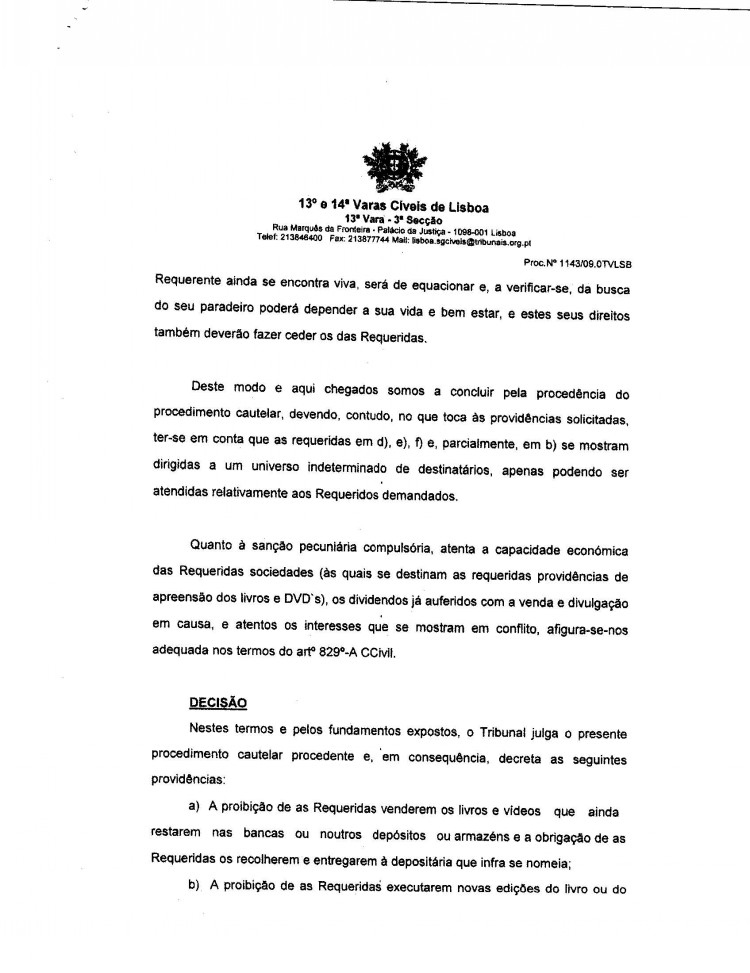
Furthermore, the Court condemns each one of the Defendant firms to pay a compulsory pecuniary sanction of 1000 Euros for each day that they do not obey the prohibitions or the order to apprehend the books and the
videos.
After having been notified of that decision, appeals were filed by:
Goncalo de Sousa Amaral,
Guerra e Paz, Editores, SA
VC - Valentim de Carvalho - Filmes, Audiovisuais, SA and
TVI - Televisao Independente, SA
All of them based on the right of
freedom of expression of thought that is
constitutionally consecrated and furthermore the
fact that the statements and facts that were
published in the book are the mere reproduction of
solid data that is part of the investigation that
was started at due time, and that said statements
and facts are even part of the investigation's
archiving dispatch that was signed by a Prosecutor
of the Portuguese Republic.
A new sentence was
issued, which basically upheld the sentence that had
been issued before and that granted the request.
Against that sentence, appeals were filed by the
four opponents. |
|
|
|
[a summary of the arguments that
were presented by the four opponents to follow]
|
|
PORTUGUESE COURT PAGES 11 TO 20 |
|
II - Legal basis and Reasons |
The following facts were proved:
From the injunction request
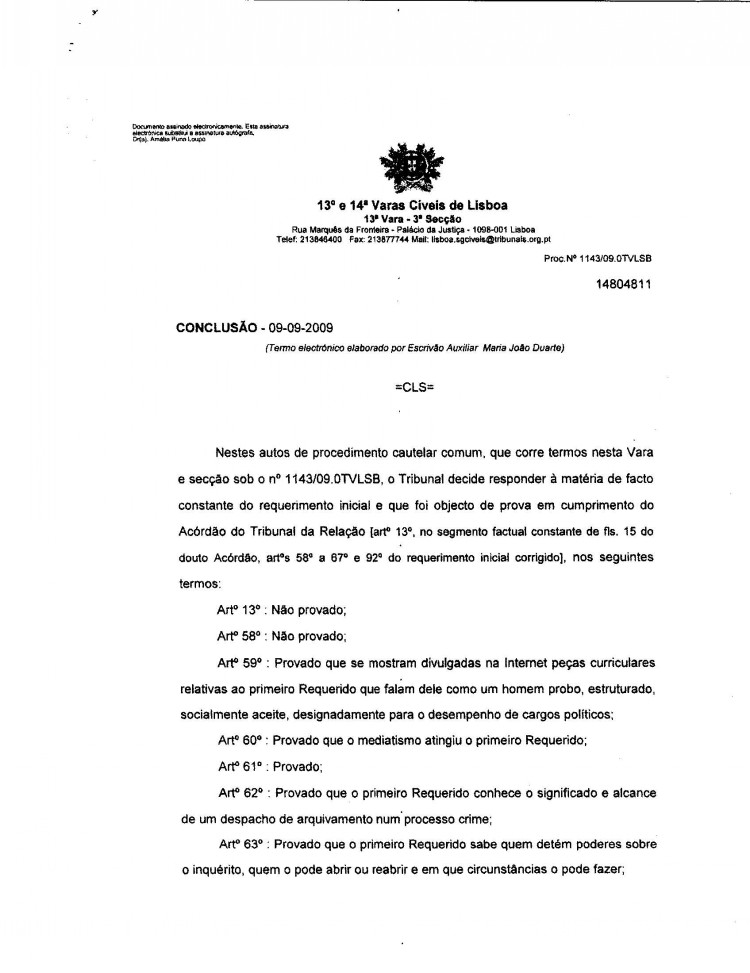
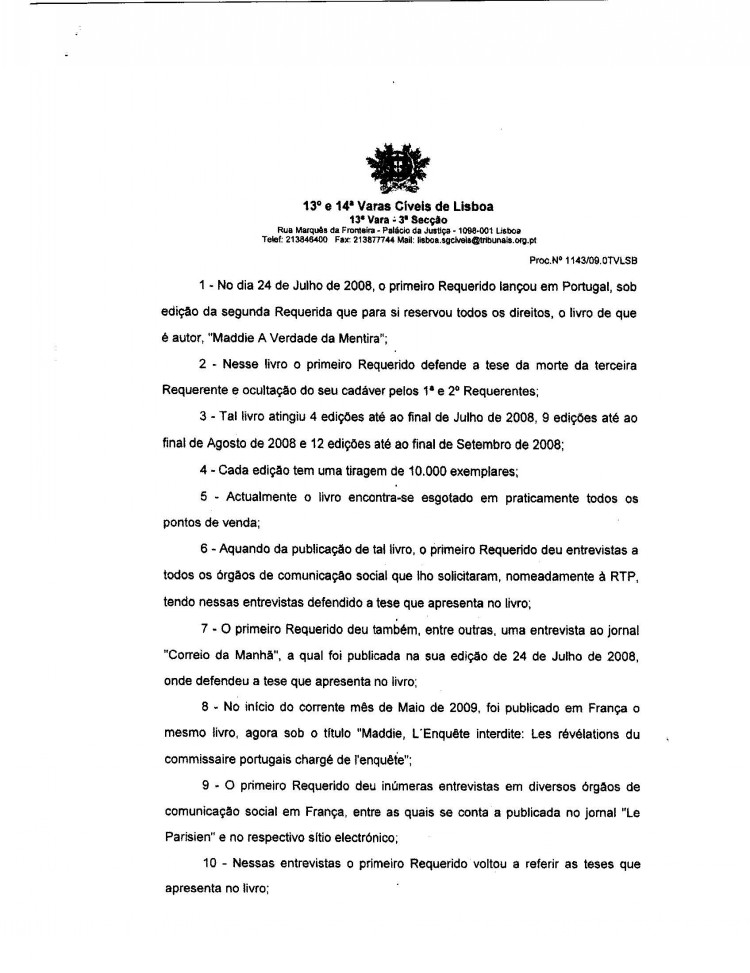
1 - On the 24th of July, 2008, the first Defendant published in Portugal, under edition of the second Defendant, the book that he is the author of, "Maddie The Truth of the Lie".
2 - In that book, the first Defendant defends the thesis that:
1) The child Madeleine McCann died in the Ocean Club Apartment, in Vila da Luz, on the evening of the 3rd of May, 2007;
2) The simulation of an abduction took place;
3) Kate Healy and Gerald McCann are suspected of involvement in the concealment of their daughter's cadaver,
4) The death may have been the outcome of a tragic accident;
5) There are indications of neglect regarding the guardianship and security of the children.
3 - The aforementioned book attained 4 editions until the end of July, 2008, 9 editions until the end of August, 2008, and 12 editions until the end of September, 2008.
4 - Each edition was comprised of approximately 10.000 copies.
5 -The book is presently sold out at practically all points of sale.
6 - When the book was published, the first Defendant gave interviews to all the media that requested him to do so, namely RTP, and in those interviews he defended the thesis that he presents in the book.
7 - The first Defendant also gave, among others, an interview to "Correio da Manha" newspaper, which was published in their edition of the 24th of July, 2008, where he defended the thesis that he presents in the book.
8 - At the beginning of the month of May, 2009, the same book was published in France, now under the title "Maddie, L'Enquete interdite:
Les revelations du commissaire portugais charge de l'enquete".
9 - The first Defendant gave countless interviews to several media in France, including the one that was published by newspaper "Le Parisien"
and its corresponding website.
10 - In those
interviews, the first Defendant once more mentioned
the thesis that he presents in the book.
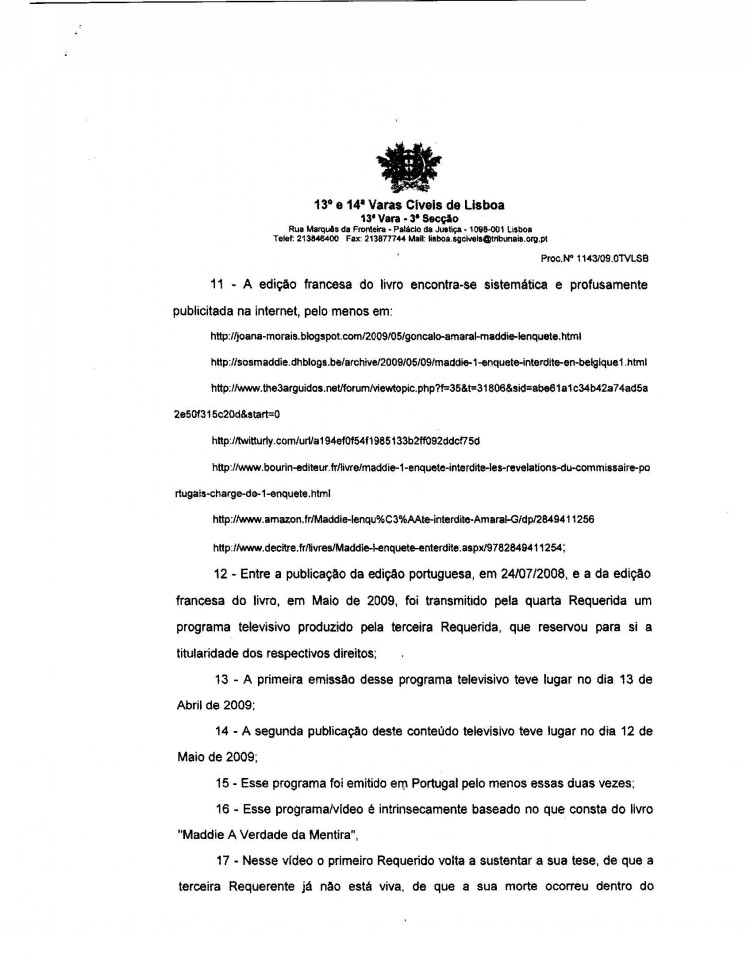
11 - The
book's French edition was and is systematically and
profusely published on the internet, at least at: [a
list of websites follows - including this blog]
|
|
|
12 - Between the date when the Portuguese edition
was published, on 24th June, 2008, and the date of
the book's French edition, in May 2009, the fourth
Defendant broadcast a television programme which was
produced by the third Defendant, that reserved to
itself the ownership of the corresponding rights.
13
- The first emission of that television programme
took place on the 13th of April, 2009.
14 - The
second emission of that television contents took
place on the 12th of May, 2009.
15 - That TV
programme was broadcast in Portugal at least on
those two occasions.
16 - The same TV
programme/video is intrinsically based upon the
contents of the book "Maddie The Truth of the Lie".
17 - In the video in question, the First Defendant
once again sustains his theory that the Third
Applicant is no longer alive, that her death
occurred within the Ocean Club apartment and that
her parents, the First Applicants, concealed the
cadaver of their daughter.
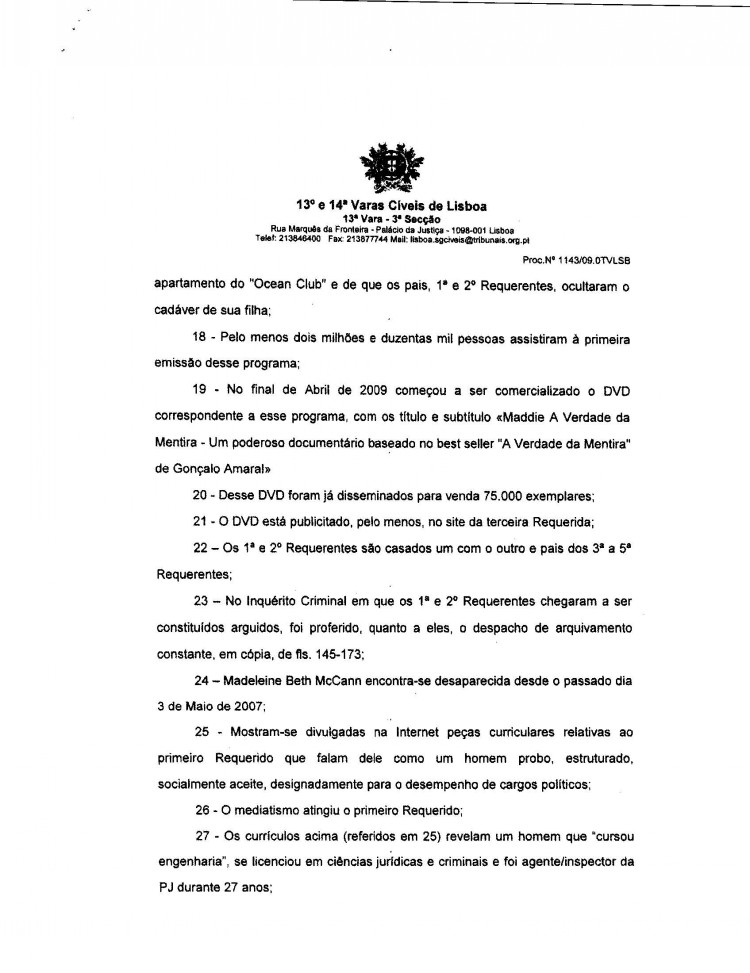
18 - At least two million
two hundred people viewed the first broadcast of
this TV programme.
19 - At the end of April 2009,
the DVD corresponding to this programme began to be
commercialised, with the title and subtitle of
"Maddie : What Lies Beneath the Truth" - A Powerful
Documentary based on the best seller "Maddie - The
Truth of the Lie" by Goncalo Amaral.
20 - 75.000
copies of this DVD have already been distributed for
sale.
21 - The DVD is published, at least, on the
web site of the Third Defendant.
22 - The first
Applicants are married to each other and are the
parents of the third, fourth and fifth Applicants.
23 - During the Criminal Investigation in which the
first Applicants were constituted arguidos, the
archiving dispatch was issued, referring to them on
pages 145-173, dated 21st July 2010.
24 - Madeleine
Beth McCann has been missing since the of 3rd May,
2007.
25 - Curricular articles were divulged on the
Internet relating to the First Defendant, that spoke
of him as a correct, structured, sociably adept man,
namely to perform political roles.
26 - The first
Defendant is a person much mentioned in the press.
27 - The curricular information previously referred
to (point 25) reveals a man who studied engineering,
graduated in legal and criminal sciences and who was
an officer/inspector of the PJ for 27 [sic] years.
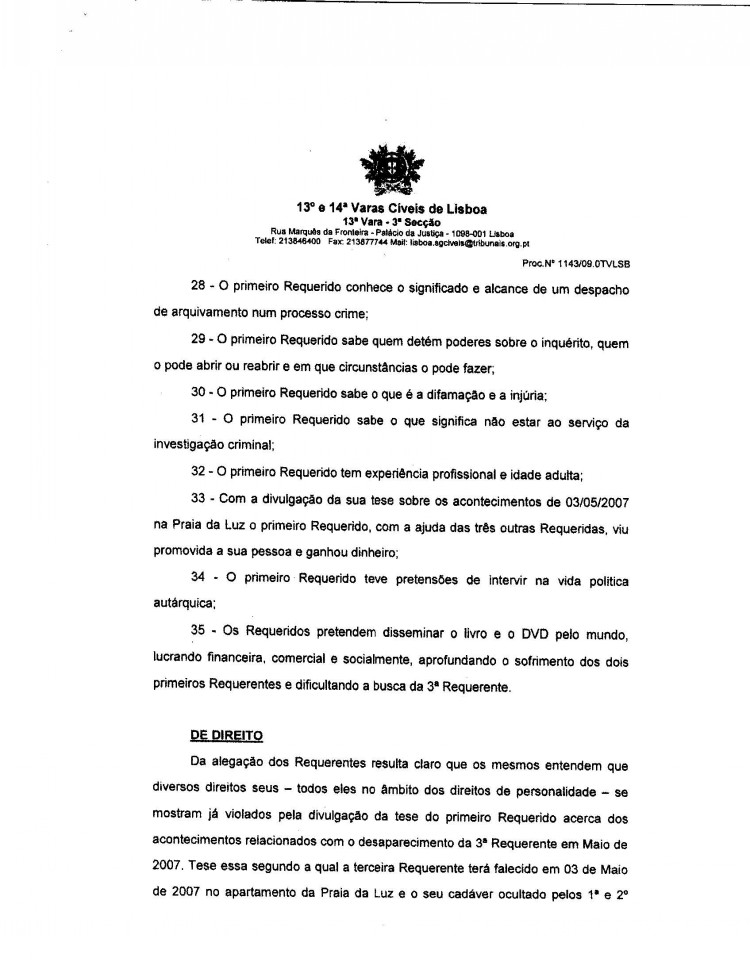
28 - The first Defendant knows the significance and
scope of an archiving dispatch in a criminal case.
29 - The first Defendant knows who holds power over
an investigation, who can open or re-open it and
under which circumstances.
30 - The first Defendant
knows what defamation and slander mean.
31 - The
first Defendant knows what it means not to be at the
service of a criminal investigation.
32 - The
first Defendant has professional experience and is
an adult.
|
|
|
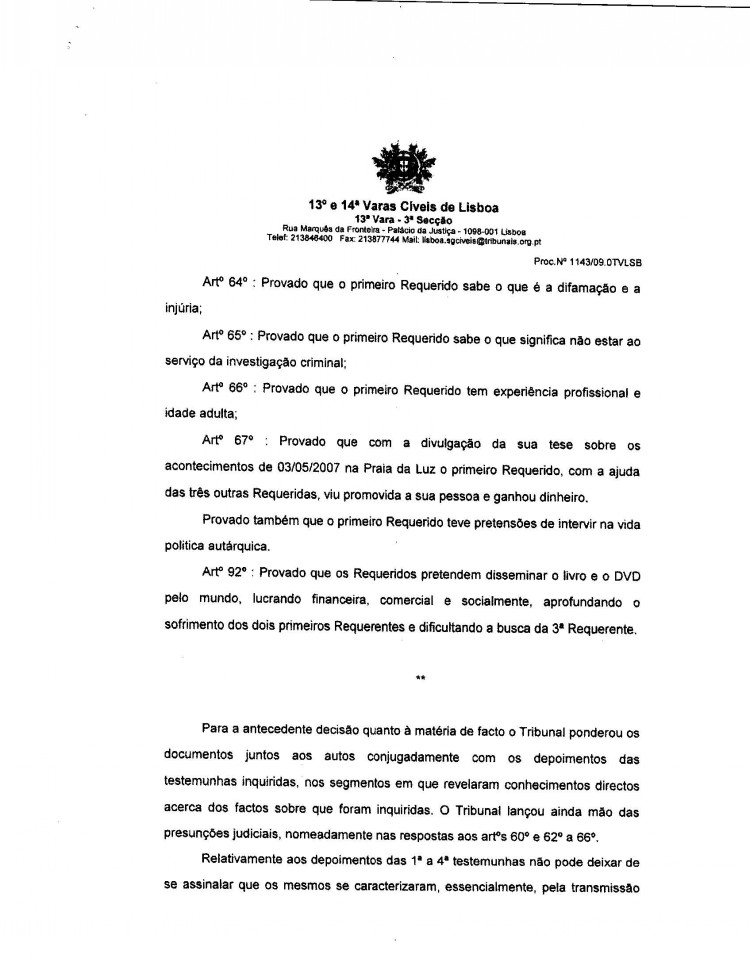
33 - With the divulgation of his theory about the events of May 3, 2007 in Praia da Luz, the first Defendant, with the help of the three other Defendants, saw himself being promoted and earned money.
34 - The first Defendant had pretensions to intervene in local political life.
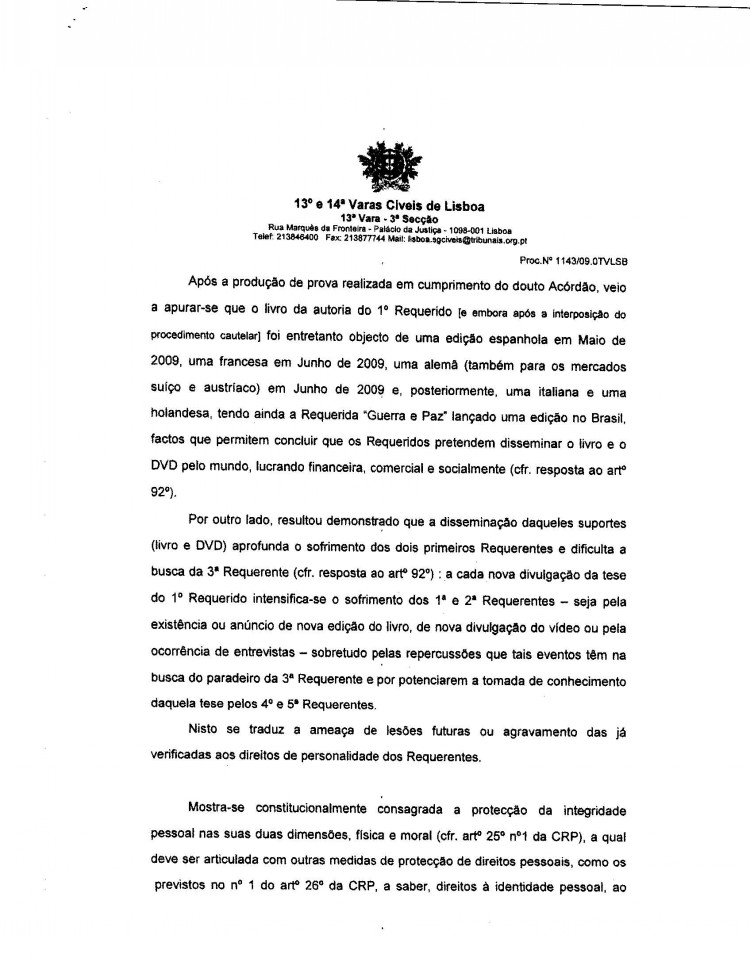
35 - The Defendants aim to divulge the book and DVD around the world, gaining financially, commercially and socially, which deepens the suffering of the first two Applicants and makes the searches for the third Applicant difficult.
From the oppositions
1 - The Defendant was the Coordinating Inspector of the "Maddie Case" Investigations from the 3rd of May, acting in this quality, within the scope of Inquest process No 201/07.0GALGS of the Lagos Public Ministry Services, until the date when he was withdrawn from the case, on the 2nd of October, 2007.
2 - He retired from service on the 1st of July, 2008.
3 - On the date that he was withdrawn from the case, it was of the Defendant's knowledge that some of the investigators had formulated the opinion that Madeleine McCann had died in the apartment, that a simulation of abduction occurred and that her parents were suspected of concealing a cadaver.
4 - The investigation activities that the first Defendant reports in the book and in the documentary are contained in the investigation process.
5 - The investigation process was made available in electronic format, namely to the national and international media, who proceeded to divulge it, thereby enabling knowledge, comments and public and universal discussion of it.
6 - Any person can have access to these facts and to the documents of the investigation process in which they were verified, on the internet, only a "click" away.
7 - The witness friends of the first Applicants did not make themselves available to appear in Portugal for a diligence of reconstruction of facts, as was determined by the dispatch from the Prosecutor's Office, on pages 4636 to 4638 of Volume XII of the Investigation.
8 - Under the terms of the editorial contract, relating to the book "Maddie - The Truth of the Lie", signed with the first Defendant, the author's rights of ownership were temporarily ceded to the second Defendant, only with regards to the editing of the book.
9 - The book was published, through other editors, in some countries (apart from France) as pointed out under item 8 of the provisional injunction, as follows:
In Spain, in September 2008, with the title "Maddie - La Verdad de la Mentira", with eventual commercialisation in Castilian language into Latin American countries.
In Denmark, in November 2008, with the title "Maddie - Sandheden on Lognem", with eventual commercialisation in other Nordic countries.
In Italy, in December 2008, with the title "Maddie - La Verita della Menzogna",
with commercialisation in the Italian language
throughout the world.
|
|
|
|
PORTUGUESE COURT PAGES 21 TO 30 |
In Holland, in April 2009, with the title "Maddie - De Waarheide Achter de Leugen", with commercialisation in the Dutch language throughout the world.
In Germany, in June 2009, with the title "Maddie - Die Wahrheit tiber die Luge", with commercialisation in Austria and Switzerland.
10 - There is an English version circulating on the internet, on the web site www.gerrymccansblogs.co.uk/PJ/TRANSLATIONS.htm, where a Portuguese version can also be found.
11 - On their web site (www.etc), the first Applicants cite the theory of the first Defendant.
12 - The Daily newspaper "Correio da Manha", in its edition of 3rd October 2007, published a supplement with the title "Maddie, The Diary of a Mystery".
13 - By means of the Fund that was created by the first Applicants, diligences that are considered to be opportune are being made in order to obtain leads about what happened to and to discover the whereabouts of the third Applicant.
|
14 - During the first trimester of 2008, "VC Filmes" learned that the first Defendant was writing a book, the publication of which would take place during the first semester of that same year, with an objective and factual description and the revelation of elements, at the time un-published, of the investigation into the disappearance of Madeleine McCann which he had led.
15 - "VC Filmes" expressed their interest to the first Defendant for an audiovisual adaptation (documentary and fiction) of said book.
16 - And with him [Dr. Amaral], an agreement was made for ceding the exclusive rights in their [VC Filmes'] favour for the adaptation of a book into a documentary or fiction that could have the format of a book for cinema or a telefilm for television and which should be explored on all platforms and on all kinds of media.
17 - The author of the book agreed to participate as narrator of the documentary.
18 - And he ceded to "VC Filmes" all the ownership of author's rights and connected rights that belonged to him as author and narrator, namely for effects of the exploration by "VC Filmes" of the documentary by all methods and by all means.
19 - "VC Filmes" ceded to the fourth Defendant the rights of television broadcast or transmission in Portugal of the audio visual documentary entitled "Maddie – The Truth of the Lie", produced by them.
20 - And, as happens with all other cinematographic and audio visual works produced by "VC Filmes", the latter ceded to its distributor "Valentim de Carvalho Multimedia, S.A.", namely the rights of edition and distribution of the documentary for publication in video format, thereby making themselves their representative as regards the exploration or commercialisation of the rights of television broadcast or transmission of this documentary in foreign countries.
21 - "Valentim de Carvalho Multimedia" in representation of "VC Filmes", ceded the rights of television broadcast or transmission of the same documentary to television stations in Spain, Andorra, France, (Flemish) Belgium, Denmark and Poland, on dates previous to the notification to "VC Filmes" of the decision presented in this injunction.
|
|
|
22 – Until that same date, the documentary in question was reproduced only once in order to be edited, published and sold in Portugal, in video format, in this case a DVD.
23 - Neither "Valentim de Carvalho Multimedia" nor "VC Filmes" had ceded any rights of edition or author's rights concerning the content of the same documentary (or the video that reproduces it) for publication in any other part of the world.
24 - The reproduction and editing were authorised by "Valentim de Carvalho Multimedia" to the company "Presslivre, Imprensa Livre, S.A.", owner of the newspaper "Correio da Manha" by means of a contract established between both parties, under which terms, the DVDs, their covers and packaging would be produced on account, by order and under the responsibility of "Presslivre", to be distributed and commercialised jointly with the newspaper "Correo da Manha".
25 - And the entire process of registration and classification of the video edition (DVD) of the documentary at IGAC would be, as it was, developed by "Valentim de Carvalho Multimedia", the costs of which process would be covered by "Presslivre", as indeed was done.
26 - 75.000 DVD units were produced for said edition.
27 - The respective distribution for sale took place together with a distribution for sale of the edition of the newspaper "Correio da Manha" on the 24th of April, 2009.
28 - Only a small number of the DVDs distributed was effectively sold, 63.369 units having been returned to "Presslivre".
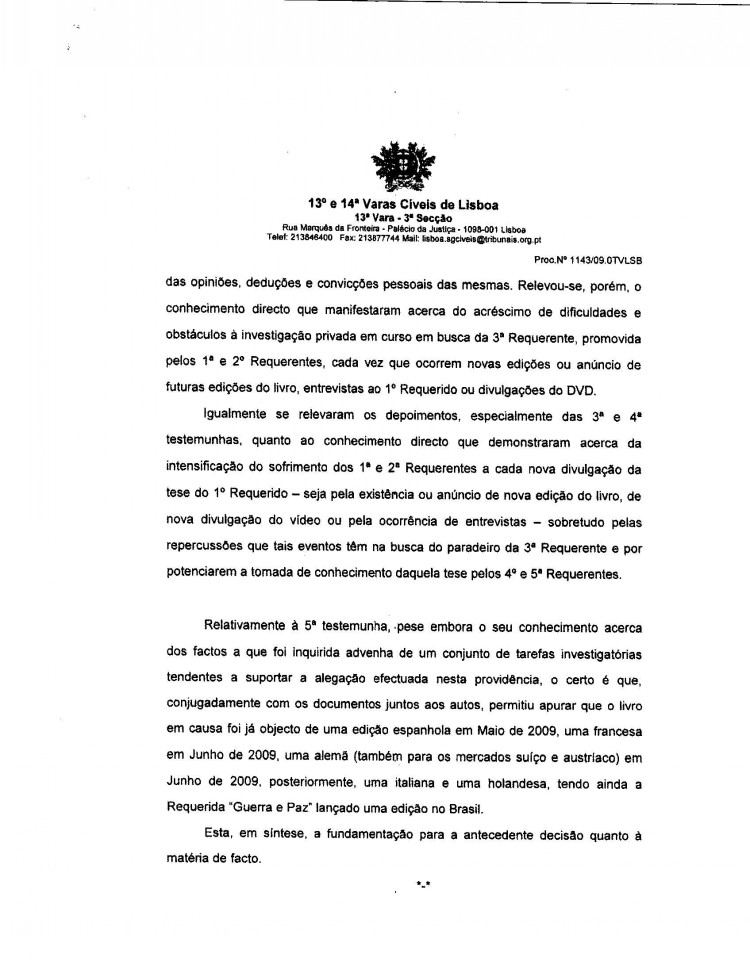
29 - The investigation files were made available in electronic format, namely to the national and foreign press, which disseminated it, enabling it to become known and to be publicly and universally commented upon and discussed.
30 - Anyone has access to those facts and to the documents from the investigation process in which they were verified, on the internet, at the distance of a "click".
31 - The documentary was published and sub-titled in English, by third parties who published it on the internet, without the knowledge and against the will of "VC Filmes".
32 - The first two Applicants, in collaboration with British television station "Channel 4" also produced a documentary about the disappearance of the third Applicant in Praia da Luz in May 2007, which expressed their version of the events.
33 - This audio visual piece, titled "Still Missing Madeleine" and which corresponds to a documentary, with a duration of 60 minutes, was subject to a preliminary licensing agreement by "Mentorn International" to "TVI", for the Portuguese territory, with an exclusivity duration for the period between 7th May 2009 and 6th May 2010.
34 - This agreement even began to be negotiated before the first screening by the Defendant [TVI] of the documentary based upon the book of the first Defendant, and was duly reduced to a written text, in the form of a "Deal Memo" (business deal), which was signed by both parties on 15th April 2009.
|
|
|
35 - "TVI" programmed the screening of this documentary with the version of the Applicants, in such a manner as to complement the showing of the documentary based upon the book by the first Defendant, seeking by acting in this way, to clarify the public in an unbiased way, showing various versions and possible explanations for the same facts.
36 - On 23rd April 2009, "TVI" was informed by telephone that "Mentorn" was not going to comply with the preliminary licensing agreement in question, which was confirmed in writing, on 5th May 2009.
37 - The reason why "Mentorn" was not going to comply with the agreement in question was that the McCann family had given instructions that they did not want the programme to be licensed to "TVI".
38 - The documentary that reports the version of facts defended by the Applicants was screened on 12th May 2009 by "SIC" channel, with the title "Maddie – two years of anguish", having been previously been broadcast in the UK.
39 - In that documentary, an explanation is given, with the help of private detectives, of the version of facts defended by the Applicants and a re-construction of the night of the disappearance of Madeleine McCann is made.
40 - The first Applicants have easy access to national and international press, having given an interview to the American television programme "Oprah", presented by the well known Oprah Winfrey and which had already been shown in Portugal, also by SIC, on 4th May 2009 and again on 12th May.
41 - That programme was transmitted throughout the entire world by means of available satellite signals and cable networks.
42 - In this interview the first Applicants once again explained their theory about the fateful events of the night of 3rd May 2007 and once again launched an appeal for her search, revealing new facts about the private investigations that they hired.
43 - In the documentary presented by "SIC", the first Applicants revealed the existence of at least one more witness statement, re-constructions and photo fits that reinforce the abduction theory.
|
After reading the proved facts, we do now have to
place them into a juridical context.
Concerning the
suitability or unsuitability of the appeals, it is
considered that the matter is solved in the dispatch
that was written at the lower court, on pages
1.359/1.367, and the appeals are all suitable.
As
was written, and well, in the decision that is under
analysis, the injunction is a legal instrument that
is destined to effectively protect subjective rights
or other jurisdictionally relevant interests. --- |
|
|
Its practical importance does not result from the capacity to solve conflicts of interest in an autonomous and definitive way, but rather from its usefulness in the anticipation of certain effects of judicial decisions, in the prevention of serious or hardly repairable violation of rights, in the prevention of financial damages or in the preservation of status quo, until the final decision on the case is issued.
It represents an anticipation or a guarantee for efficacy concerning the outcome of the main case and it is based on a summary analysis (summaria cognitio) of the factual situation that allows to state the right as being likely (fumus boni iuris) and the justified fear that said right may be seriously damaged or rendered useless, if a certain injunction is not decreed (periculum in mora).
It is, after all, an antechamber of the main
process, and it allows for an interim or provisory
decision to be issued, with the purpose of
diminishing the erosive effects that derive from the
delay in a definitive solution, or to render
fruitful the decision that may be favourable to the
Applicant.
Article number 381º, no 1 of the Civil
Process Code stipulates that whenever someone shows
a well-based fear that someone else may cause a
serious and hardly repairable damage to his or her
right, that person may request the conservatory or
anticipatory injunction that is specifically
adequate to ensure the effectiveness of the right
that is under threat.
On the other hand, article
387º, no 1 of the same diploma establishes that the
injunction is decreed whenever there is a serious
possibility of the existence of the right, and the
fear of its lesion is sufficiently well-based.
Therefore, the injunction is a means, and not an
end. It does not seek to directly and immediately
carry out the substantial right, but rather to take
measures that ensure the efficacy of a subsequent
providence, which is actually destined to act on the
material right.
Therefore, the injunction is of a
provisory nature and always depends on a cause
(preliminarily or incidentally) - article 383º, no 1
of the Civil Process Code.
|
|
|
Thus the success of the injunction depends on two requisites:
a) the verification of the appearance of a right;
b) the demonstration of the danger of said apparent right not being satisfied.
Concerning the first requisite, the court is asked to appreciate or to judge on a mere possibility or verisimilitude (bonus fumus juris).
As far as the second requisite is concerned, a
judgement of stronger and more convincing
probability is at stake.
|
The fear of serious and hardly repairable damage that is mentioned in article 387, number I of the Civil Process Code means "present and founded fear".
The fear is founded when it is of such nature that it justifies the requested injunction; and it only justifies it when circumstances present themselves in a way that convinces that damage to said right is imminent.
In the a quo Court's decision the dangers of lesion to the applicants' physical integrity or their treatment in a degrading, cruel or inhumane manner are promptly set aside.
The dangers of lesion to the applicants' reservation of private and family life subsist, as well as the lesion to their right to image and a good name and the right to usufruct from the penal process' guarantees, namely the right to a fair investigation and the right to freedom and to safety.
In an opposite position are the rights of the defendants – the right to freedom of expression of thought and the freedom of press.
Honour, the right to a good name are personality rights that are densely defended and protected by several legislative orders:
Right away, by the constitutional order (confront article 26 of the Portuguese Republic's Constitution), and also in the international order.
|
|
|
Ordinary law also protects the same rights, as can be understood by reading articles 70, 72 and 484 of the Civil Code.
As it has to be, jurisprudence strongly reflects that general tutelage and the defence of citizens' good name and image.
By all, one should read the very recent Ruling from the Supreme Court of Justice dated 20.01.2010 (Presiding Judge: Fonseca Ramos), that can be reached on the internet, on the Court's database that is lodged under the address www.dgsi.pt/:
I) - One of the limits to the freedom of information, which is therefore not an absolute right, is the safeguard of the right to a good name. Journalists, [and] the media, are bound to ethical, deontological duties of rigour and objectivity.
II) – The media have the right, the social duty, to disseminate news and to emit critical or non-critical opinions, and it is important that they do so while respecting the truth and the intangible rights of others, like personality rights.
III) – The right to honour in a wider sense, and the right to freedom of press and of opinion are traditional areas of conflict.
IV) ...
V) – Criticism is limited by the targeted person(s)' right, but it does not lose legitimacy if it is slashing, sharp, as long as not insulting, because every so often that is the writer's style.
VI) ... VII) ... VIII) ...
IX) – To criticise implies to censor, censorship that takes place in the media only stops being legitimate as a manifestation of individual freedom when it expresses objective antijuricity,
|
|
|
violating rights that are extremely personal and which affect, in a more or less lasting way according to men's memory, goods that have to be preserved like the ones that are at stake here, to a good name and to social prestige.
The right to inform is nowadays unanimously
accepted as a fundamental demand of democratic
societies of pluralist expression, it is consecrated
by Article 37º of the Portuguese Republic's
Constitution
The rights of citizenship, which are
the basis of social life, constitute the core of the
very personality (physical and moral) of the human
being; thus the right to life, to physical and moral
integrity, to a good name, to image, to freedom, to
the protection of intimacy are consecrated
constitutionally (articles 24º, 25º, 26º) and in
civil law (articles 70º and 484º of the Civil Code).
Due to the fact that all of these rights are
constitutionally protected, in principle none of
them raises above the others, and - in its practical
exercise - each one of them should cede as strictly
necessary and in a proportional way, in order to
accommodate the adequate practice of the rest of
them.
Necessity, proportionality and adequacy are
the fundamental principles for the practical
conjugation of the concrete exercise of said rights;
therefore, the rules that are to be respected must
be set case by case, thus allowing to decide which
conflicting rights must be compressed, what limits
have to be observed and what dominant rights must be
protected.
And it is through a cautious pondering of
the rights at hand that we will be able to extract
some conclusions concerning this specific case.
The
book that was written by the first defendant, Dr.
Goncalo Amaral, presents a thesis that was at one
time defended by several participants in the police
investigation: that little Madeleine died
accidentally and that her parents, here the first
applicants, were suspected of concealing the
cadaver.
|
|
|
This defendant was the Coordinating Inspector of
the investigation into the case of the
disappearance, thus being the most qualified police
officer who intervened in the investigation until
the time when, through a decision from the Judiciary
Police's (PJ) directory, he was removed from that
function.
In that role, the defendant was
deeply involved in the entire investigation and had
the opportunity to formulate all of the possible
conclusions about the case, while it was under
investigation.
Approximately 5 months later, Dr.
Goncalo Amaral was removed from the investigation
through a decision of the PJ's directory.
As he
clarifies several times throughout the book, the
author felt the need to write it right away in order
to, as he says, "recover my good name, which was
publicly dragged through the mud while the
institution that I served for 26 years, the
Portuguese Judiciary Police, did not allow me to
defend myself, nor defended me institutionally. I
asked for permission to speak out in that sense, a
request that remains unanswered to this day. I fully
respected the PJ's rules, and remained in silence.
Nevertheless, said silence was tearing my dignity
apart.
Later on, I was removed from the
investigation. I then decided that it was time for
me to defend myself in a public way. Therefore, I
immediately requested my retirement, so I could
regain the plenitude of my freedom of expression."
This is a first point - and one that is not small -
that should be registered: the author feels he is
the victim of injustice and wants to re-establish
the truth, at least his truth or his vision of
truth, even more so as he felt that his honour was
being diminished and the police force that he owed
obedience to did not allow him to reply, as a police
officer, to those attacks against his professional
pride and his honour as a qualified criminal
investigation police officer.
|
|
|
In the book that is at stake here - "Maddie - the Truth of the Lie" - the author presents a vast multiplicity of facts and then offers his interpretation of said facts.
Those facts are all part of the investigation and are exhaustively considered and weighed in the archiving dispatch of the process that is on the DVD which has been appended to this court case (page 441).
In that description, there are main facts and others that are secondary, but which the author attributes value to, based on his experience as a police investigator, an activity that he has performed for 26 years.
The author describes, in detail, several facts and circumstances that were not coherent in between each other, from the outset of the investigation, thus prompting contradictory conclusions.
In the archiving dispatch that is signed by two Public Ministry Magistrates, it is written that "From the analysis of the set of depositions that were made it became evident that important details existed which were not fully understood and integrated, which needed to be tested and verified on the location of events itself, thus rendering it possible to establish the apparent failures to meet and the lack of synchronisation, even divergences, in a diligence that is suited for that effect, which was the reconstitution, which was not possible to perform, despite the commitment that was displayed by the Public Ministry and by the PJ, to attain that purpose ..."
In that very same dispatch, the result of the tests that were performed by the sniffer dogs "Eddie" (a dog that was specially trained to signal cadaver odour) and "Keela" (specially trained to detect the presence of human blood) are mentioned.
"Eddie" marked (signalled) cadaver odour:
in the McCann couple's bedroom in apartment 5-A (from where little
Madeleine disappeared) in the area next to the wardrobe;
|
|
|
in an area next to the living room window that has direct access to the street, behind a sofa;
and in an area of the same apartment's garden.
The dog "Eddie" again marked the signal of cadaver:
at the "Vista do Mar" villa, which was rented by the McCann couple after Madeleine's disappearance, in the area of a wardrobe that contained a soft toy that had belonged to the little girl;
on clothing that belonged to the applicant Kate Healy, Madeleine's mother;
on the outside of the Renault Scenic vehicle with the license plate number 59-DA-27, that was rented by the McCann couple after the disappearance, next to the driver's door;
and on that vehicle's key/card.
The dog "Keela" detected residues of human blood:
in the same living room of apartment 5-A, which had already been signalled by "Eddie";
after the floor tiles that had been signalled during the first inspection had been removed, she again signalled the spot where the floor tiles had been;
on the lower part of the window curtain that had already been signalled by "Eddie" before;
on the inside of the boot of the Renault Scenic vehicle that had already been signalled by "Eddie";
and in the door storage compartment on the vehicle's driver's side, which
contained the car key/card;
The dogs' indications cannot be used as evidence in
court, but in multiple cases they provided precious help in terms of collection
of evidence for the Scotland Yard and the FBI, with positive results.
|
|
|
|
PORTUGUESE COURT PAGES 31 TO 37 |
These indications were later not corroborated by
the British forensics lab that was chosen by the
investigation, but they were enough to constitute
the applicants, Madeleine's parents, as arguidos in
the criminal investigation that was performed over
her disappearance.
In possession of that new data,
and crossing it with the data that had been
collected before, the Portuguese authorities - the
Public Ministry and the Judiciary Police - tried to
perform a reconstitution of the facts, they did and
tried everything, but due to the lack of
availability of the McCann couple and their friends,
who did not show up, said diligence could not be
performed and those facts still remain to be
clarified.
Concerning that matter, it is written in
the final dispatch that "(...) despite the fact that
the national authorities took all measures to render
their travelling to Portugal possible, due to
motives that are unknown, after the many doubts that
they raised concerning the need and the opportunity
of their travelling were clarified several times,
they chose not to show up, which rendered the
diligence impossible to perform.
We believe that the
main damaged party were the McCann arguidos, who
missed the possibility to prove what they have
protested since they were made arguidos: their
innocence towards the fateful event; the
investigation was also hindered, because said facts
remain unclear (...)".
In any case, the fact is that
the indications that were mentioned above were
sufficient to make the McCann couple arguidos.
The
subsequent collection and production of evidence,
namely the forensics evidence that was collected and
treated in laboratory, weakened that conviction and
thus the couple stopped being arguidos. What is
certain is that since the start of the investigation
there were incongruent and even contradictory
situations concerning the witness statements; the
telephone records of calls
|
|
|
that were made and received on mobile phones that
belonged to the couple and to the group of friends
that were on holidays with them; the movements of
people right after the disappearance of the little
girl was noticed, concerning the state in which the
bedroom from where the child disappeared from was
found (closed window? open window? partially open
window?) etc., and the mystery would only become
even thicker due to the clues that were left by the
already mentioned sniffer dogs.
All of this is
reported in detailed manner in the book that is at
stake here, reproducing the contents of some of the
case files, which also had an effect on the above
mentioned final dispatch that was signed by two
Public Ministry Magistrates.
In the book, we do not
verify any reference to any facts that are not in
that dispatch.
Where the author differs from the
Prosecutors who have written the dispatch, is in the
logical, police-work-related and investigative
interpretation that he does of those facts.
In that
aspect, we stand before the exercise of freedom of
opinion, which is a domain in which the author is an
expert, as he was a criminal investigator for 26
years.
Let us now analyse the juridical focus of the
rights that were invoked by the applicants:
As
mentioned above, the Court's decision a quo
immediately put aside the dangers of damage to the
applicants' physical integrity or their treatment in
a degrading, cruel or inhumane way.
The following
dangers subsist:
1. damage to the reservation of the
applicants' private and family life;
2. damage to
their right to image and a good name;
3. damage to
their right to the guarantees of the penal process,
namely the right to a fair investigation and the
right to freedom and safety.
|
|
|
Concerning the applicants' reservation of private
life, we verify that they themselves have given
numerous interviews and intervened in the media,
thus giving them [the media] information that would
hardly be publicised by any other means: this
includes the documentary that was produced by the
British TV station "Channel 4", which had the
applicants' cooperation and was widely broadcast in
the United Kingdom and later on in Portugal (ref.
Nos. 32 to 35 of the aforementioned proven facts);
one should pay attention to the fact that the
applicants have easy access to the national and
international media, having given an interview to
North American television talk show "Oprah" hosted
by the well-known Oprah Winfrey, which was already
broadcast in Portugal, also by SIC, on the 4th of
May, 2009, and again on the 12th of May (ref. No. 40
of the same facts).
Concerning this matter, the
Civil Code establishes as follows:
Article 80º
(Right to reservation over the intimacy of private
life)
1. Everyone must maintain the reservation over
someone else's intimacy of private life.
2. The
extent of reservation is defined according to the
nature of the case and the persons' condition.
Article 81º
(Voluntary limitation of personality
rights)
1. All voluntary limitation of the exercise
of personality rights is null if it is contrary to
the principles of public order.
2. The voluntary
limitation, whenever legal, is always revocable,
although with the obligation to indemnify any
damages that were caused to legitimate expectations
of the other party.
We conclude that the applicants
voluntarily decided to limit their right to the
intimacy of private life, certainly envisaging
higher values like the discovery of their daughter
Madeleine's whereabouts, but upon voluntarily
limiting that right, they opened the doors for other
people to give their opinion about the case, in
synchrony with what they were saying, but also
possibly in contradiction with their directions, yet
always within the bounds of a legitimate and
constitutionally consecrated right to opinion and
freedom of expression of thought.
|
|
|
We do not see that the right of the book's author,
the defendant, can be limited by a right to the
reservation of intimacy that suffered voluntary
limitations by their holders, the applicants.
In the
same way, concerning the applicants' right to image
and a good name: upon placing the case in the public
square and giving it worldwide notoriety, the
applicants opened all doors to all opinions, even
those that are adversarial to them.
In any case, we
understand that the allegation of facts that are
profusely contained in the judicial inquiry and that
were even published through an initiative of the
Republic's Attorney General's Office, can in no way
be seen as an offence against the right to image and
a good name of the subjects in the process.
Finally,
concerning the damage to the right to usufruct from
the penal process' guarantees, namely the right to a
fair investigation and the right to freedom and
safety, we still cannot understand how it is
possible for said rights to be offended by the
contents of a book that describes facts from the
investigation, although it parts from the
interpretation that the Public Ministry's
Magistrates made of those facts, yet offering based,
solidly built and logical interpretations.
We thus
reach a point where it seems to be important to
stress the following: the indicative facts that led
to the applicants' constitution as arguidos within
the inquiry were later on not valued by the Public
Ministry's Magistrates in order to lead to a
criminal accusation, but those very same facts, seen
through another prism and with another base, may
lead to a different conclusion from that which was
attained by those same Magistrates - those are
indications that were deemed to be insufficient in
terms of evidence in a criminal investigation, but
they can be appreciated in a different way, in an
interpretation that is legitimate to be published as
a literary work, as long as said interpretation does
not offend any fundamental rights of anyone involved - and we have written above
already why we understand that said interpretation
does not offend the applicants' rights.
|
|
|
In a concise
manner:
The book at stake in this process - "Maddie
- the Truth of the Lie" - which was written by the
defendant Dr. Goncalo Amaral, has the main
motivation of defending his personal and
professional honour, as the author points out right
away in the preface and throughout his text.
The
contents of the book does not offend any of the
applicants' fundamental rights.
The exercise of its
writing and publication is included in the
constitutional rights that are secured to everyone
by the European Convention on Human Rights and by
the Portuguese Republic's Constitution, namely in
its articles 37º and 38º.
|
|
|
As we arrive at this point, we conclude that the
decision that was made by the Court a quo must be
revoked, and the analysis of the other issues that
are placed under appeal are not justified, as they
are considered prejudiced.
The appeal by defendant
Dr. Goncalo Amaral is sustained.
The other appeals
are not taken into consideration, as it is
understood that their appreciation is prejudiced -
article 660º, no 2, of the Civil Process Code.
III -
Decision
In harmony with what is written above,
under the terms of the cited dispositions, the
Judges at this Appeals Court declare the validity of
the appeal filed by defendant Dr. Goncalo Amaral,
and the sentence of the Court a quo is revoked, its
disposition replaced by the following:
The
injunction is deemed not valid because it was not
proved.
Furthermore we deliberate that we do not
acknowledge the rest of the appeals.
Costs to be
paid by the appealed parties [the McCann couple and
their three children].
Lisbon and Appeals Court,
14.10.2010
|
|
|
The Appellate Court Judges,
Francisco Bruto da Costa
Catarina Arelo Manso
Antonio Valente - |
|
| |
|
LISBON CIVIL COURT DECISION 18 FEBRUARY 2010 |
|
WITH THANKS TO
ALBERT MOISIU FOR TRANSLATION |
|
|
Introduction
This is my summary of the decision document handed
down by the Lisbon Civil Court on 18 February 2010,
a copy of which was made available on the Internet
by
Duarte Levy.
It is not a literal, word-for-word translation of
the document, merely my translation / interpretation
of it. I apologise in advance to the judge and to
the Court for any mistranslation, misinterpretation
or misunderstanding of the content on my part. As
always I have attempted, within my limited
understanding of Portuguese, to be faithful to what
was written in that language.
Grammatical and spelling errors in the English, my
native tongue, are solely my own.
This summary is produced without compensation of any
kind. It is not for sale nor may it be used by any
other person in any manner for purposes of sale. It
may be distributed freely, and only for free, with
or without acknowledgement to my authorship.
Albert Moisiu
March 2010
The main decision
document:
http://duartelevypt.files.wordpress.com/2010/02/doc-2a.pdf
The supplementary
hearing document:
http://duartelevypt.files.wordpress.com/2010/02/doc-1a1.pdf |
|
|
|
|
* * *
At the outset, it is my understanding, and I am sure the
reader will understand
similarly, that the court document is itself a summary; one
that was produced by the
presiding judge and her aides, containing only those points
arising from hearing
papers/documents collected and collated by the Court from
the previous injunction
hearings in 2009, open-court sessions, private discussions,
correspondence and
submissions between and by all parties, that the judge
deemed to be pertinent to the
matter before her. It also contains her legal cogitations so
that they may reviewed and assessed by superiors, peers and
subordinates alike, especially in the event of an appeal to
a higher authority. Finally, it ends with her decision
which, she hopes, will be seen to flow naturally from what
went before.
It is not a replica of everything that occurred before and
during the hearings. It is her
assessment of what she heard and read, and her extraction
and summation of what she believed to be relevant.
Section I
It starts with section I – Report in which the
Applicants are named as the five members of the McCann
family in the following order (which is important to
remember) – the two parents, the missing child, the
remaining two children – along with the four Respondents -
Goncalo Amaral, Guerra e Paz Publishers, Valentim de
Carvalho films and media, and TVI Independent Television –
in that order.
Applicants' allegations
The Applicants allege that the theory contained in the book
written by the first
Respondent, published by the second, turned into a video by
the third, which video was broadcast on television by the
fourth, violates various [legal] rights of all the
Applicants and causes them to fear future serious and
irreparable injury/damage [in the legal sense; not
physically].
The rights enumerated are:
a) the rights of the third Applicant [the missing child] to
her moral and physical integrity and to a fair and adequate
future investigation into her disappearance;
b) the rights of the remaining children to their moral and
physical integrity and to a fair
and adequate future investigation into the disappearance of
their elder sister, as well as their right to a private life
and to the good name of the family to which they belong, and
their right to freedom and security;
c) the rights
of the parents to their image, good name, good reputation
and to the
preservation of the integrity of their private life, the
right to freedom and security, the
right to their moral integrity, the right to not be treated
in a degrading, cruel or
inhuman manner, the right to the fruits [use?], like any
citizen, of the guarantees of the penal process.
The document goes on to repeat the six provisions of the
temporary injunction decision from the earlier hearing in
September 2009 at which the Respondents had not been heard,
and then proceeds to outline the main arguments of each
Respondent against those six provisions.
Respondent 1 opposition
Goncalo Amaral's main arguments were that he was incorrectly
included in the provision pertaining to cession of
publishing and author rights because his rights thereto had
already been ceded by contract to the second and third
Respondents; that the terms of the injunction were so wide
and vague as to preclude him from speaking about the
official inquiry as well any matter relating to it that had
already been disseminated through the media; that he had
never said the missing child's parents had killed her and
hidden the body, rather that he defended that there had been
suspicions of involvement in the hiding of their daughter's
body; and that at the date he was removed from the case the
investigators had formed the opinion that the child had died
in the apartment, that an abduction had been simulated and
that the parents were suspects in the hiding of the body.
He closed by asking for the provision that prevented him
from stating his opinion about
the child's death and from speaking about the "Maddie case"
investigation to be
adjudged unconstitutional, and that the entire injunction be
revoked as being without
foundation.
Respondent 2 opposition
The main thrust of the publisher's opposition to the
injunction lay in the fact that former police inspectors
had, and continue, to write about police investigations and
cases; that information about the "Maddie case" was
widespread around the world in books – through various
publishing houses – in newspapers and in Internet websites,
including international sites on which books may be bought,
exchanged and sold; that the Applicants' own website had
displayed the same theory as that contained in the book;
that his company held authorisation to publish the
photographs contained in the book; that there was no
contract between his company and the other two Respondent
companies with respect to the DVD or video broadcast; that
the book had been published for more than a year, and the
language variants for many months, such that any capacity
they might have had to cause any damage had long since
passed; and that through the Fund established by the parents
work was currently ongoing to find out what had happened and
to determine the whereabouts of the child.
Finally, it concluded with a request for the temporary
injunction to be revoked and the
impounded books returned.
Respondent 3 opposition
Aside from technical issues pertaining to the video itself,
the video producer/distributor
arguments included assertions that neither the book nor the
video stated that the
missing child had been killed in the apartment or that the
parents had hidden her body,
rather that both conveyed that the police officers in the
disappearance investigation up to the date of October 2007
had held suspicions that the child had died and that the
parents were suspected of being involved in hiding the body
of their daughter.
The arguments continue with explanations that the foundation
of those suspicions are
contained in
the official case file, the content of which was digitised
and distributed to
the general media, foreign and domestic, for them to
disseminate that information, and
that the video concludes with the following statement:
"The mystery persists; the former inspector believes that
one day the truth will be
known. At this time we know only that Madeleine Beth McCann
disappeared from Praia
da Luz on 3 May 2007. She was 3 years old and a happy
child."
They ended with a request for the injunction to be revoked.
Respondent 4 opposition
The arguments from TVI were extensive and intensive
beginning with an invocation of
Article 37 (freedom of speech) of The Portuguese
Constitution and a statement that the boundaries defined
therein had not been exceeded; that it's sole intention in
broadcasting the video had been to inform the public and to
clarify aspects of the case; that it had made no judgement,
comment or observation with respect to the theory of the
first Respondent nor to that of the Applicants that their
daughter was found gone and had been abducted from the
bedroom where she had been sleeping with her siblings.
The full preamble to the TVI screening of the video is
included in their submission to
support their above argument:
"The program that follows is a documentary based on the book
of Goncalo Amaral,
former PJ inspector who investigated the disappearance of
Madeleine MacCann [sic] in the Algarve. His version of
events is repudiated by the parents of Maddie who continue
to defend that it be treated as a case of abduction.
"The criminal case constructed by the Portuguese authorities
ended with the
archival of the inquiry, a decision contested by Goncalo
Amaral.
"Not pointing to those responsible, a task incumbent upon
Justice [*], the
broadcast of this documentary is intended to contribute to
enlightenment about the case that remains a mystery to be
unveiled, after almost two years, and to facilitate [make
available] things that help in its understanding on the part
of public opinion."
[*] The word 'justica' here may be an unintended play on
words having the possible
double-meaning of 'judicial authorities' and 'natural
justice'.
TVI go on to point out that the parents themselves, in
collaboration with UK TV Channel 4, produced a 60-minute
documentary entitled "Still Missing Madeleine" about their
version of events relating to the disappearance – including,
with the assistance of private detectives, their
reconstruction of the night in question - which was licensed
by Mentorn International to TVI for one year between 7 May
2009 and 6 May 2010. TVI had scheduled the program to be
broadcast to show the public that there were various
versions of the same events, but on 23 April 2009 Mentorn
advised TVI that they would not comply with the agreement,
confirming this in writing on 5 May 2009, due to
instructions having been received from the McCann family
that the documentary should not be licensed to TVI. Instead,
it was subsequently broadcast in Portugal on 12 May 2009, by
SIC [a second independent TV channel], after having been
broadcast previously in UK.
It was argued that the Applicants have easy access to
national and international media through which they have
profusely transmitted their theory of the events of the
night of 3 May 2007, one example being the Oprah Winfrey
interview broadcast in Portugal, also by SIC, on 4 May 2009
and again on 12 May in which the parents, once again, put
forward their theory about that fateful night and once again
launched an appeal, revealing new facts about their private
investigations.
The arguments
conclude with a request for the revocation of the
injunction.
Applicants' rebuttal
The judge's report proceeds with her summary of the
Applicants' rebuttal of the above
arguments.
With respect to Goncalo Amaral they make some technical
legal points about his right as an author and the content of
the contract with VC Filmes, otherwise dismissing the rest
as being nothing new.
With respect to the publisher they argue that the book had
been ready for publication
since April 2008, and, regarding the Internet blogs, they
allege that the publishing
company knew the author of the blog that had appropriated
the name of the father.
They adduced further that, through things observed on the
Internet, it was clear that
that site had nothing to do with the parents.
On this point they request an official condemnation of the
publisher as a 'bad faith
litigant' and recompense as defined in Civil Process Code
(CPC) Article 457.
[NOTE: For anyone interested in further reading, the 'Notion
of Bad Faith' is defined in
CPC Article 456 and it is interesting to note that the
request does not explicitly stipulate which of the
conditions in that Article were applicable, in their view,
in this instance.]
The rebuttal of TVI was simply that there was nothing new.
With VC Filmes they again raised a technicality on cession
of rights and raised a further request for a 'bad faith
litigant' condemnation and recompense, in this instance
being specific in alleging the omission, distortion and
confounding facts relevant to the matter in question, citing
documents which were available to the judge and parties, but
not to us.
Respondent counter arguments
The report continues with the Respondent counter-arguments
to the Applicants' rebuttal and the 'bad faith' requests:
VC Filmes responded simply that there can be no possible
confusion arising from the use of the universally recognised
symbol for copyright, namely '©'.
The publisher responded than insofar as the blogs were
concerned they are authored by the Applicants or by someone
with their knowledge and approval given that the
Applicants had done nothing to prohibit them.
Supplementary hearing: separate document
At this point there was a supplementary hearing, possibly a
'side bar' or probably 'in
chambers', on the above matters.This hearing was recorded in
a second document, the essence of which was firstly:
– a recapitulation of the 35 points of the Applicants'
submission to the Court;
– seven points from Goncalo Amaral's arguments, with the
judge concluding that it
had not been proven that the parents had opposed the
official reconstruction;
– six points from the publisher's arguments, with the judge
concluding that it had
not been proven that the parents had agreed to the
publication of the Portuguese
version and an English translation of Goncalo Amaral's book
on an Internet
website;
– eighteen points from the VC Filmes' arguments, with the
judge concluding that it
had not been proven that the excess number of [video] DVD
copies had been
destroyed by 'Presslivre' with the agreement of 'VC
Multimedia', nor that at the
date VC
Filmes had been notified of the terms of the temporary
injunction there
had been no residual copies of the video in any other
repository or warehouse;
– twelve points from TVI's arguments, there being no
reservations expressed by the
judge on those points.
[Note that all these points are enumerated in Section II of
the main document
below, so I have not written them out in detail here]
Court's assessment
Other than those unproven matters above, everything else was
not considered to be
relevant to the matter before the court.The supplementary
hearing document proceeds with a statement from the judge
that the Court formed it's opinion from a critical analysis
of the documents in conjunction with witness testimony,
specifically those segments which revealed direct
[first-hand] knowledge of the things about which they were
questioned, which segments are then enumerated:
– from magistrate Jose Cunha de Magalhaes e Menezes it was
found that a DVD
divulged all pieces of the Inquiry, with certain
limitations; he spoke of several
diligences carried out during the inquiry; he had not read
the book written by the
former Inspector; he had seen part of the documentary based
on it; he explained
passages from the archival statement issued by the Public
Ministry, as well as
what had rendered the official reconstruction infeasible.
– From serving PJ Inspector Vitor Manuel Tavares de Almeida
certain inquiry work
and official statements were confirmed; he had read the book
of the first
Respondent stating that its conclusions were the same as
his, taking into account
the history of the investigation, which [investigation] was
far from complete;
– Serving PJ Inspector Ricardo Manuel Goncalves Paiva had
been involved in the
inquiry from beginning to end; he had been a link with the
family due to his
fluency in English; he had read the book stating that what
is in the book is in the
inquiry; he noted that they continue to receive information
for the case file;
– Serving head of the national anti-terrorism unit, Luis
Antonio Trinidade Nunes
Neves, had been asked by the head of the national
directorate of the PJ to support
their efforts; up until the parents were made arguidos he
had been in the Algarve
on a regular basis; he had participated in meetings with
English colleagues; he
had read a few passages of the book, finding them to be no
different from those in
the case file;
– Francisco Moita Flores, former murder and armed robbery
Inspector of the PJ,
noted commentator on crime, and friend of the first
Respondent had read the case
file, facilitated by journalists, as well as the book
written by Goncalo Amaral;
– Jose Manuel Morais Anes, retired senior criminalist from
the Police Science
Laboratory, had skimmed the book and had no knowledge of the
case file; he had
watched the video; he expressed some opinions about the
case, from a forensics
perspective, particularly the failure to isolate the crime
scene;
– Mario Rui da Silva Sena Lopes, editorial manager for the
publisher from July 2007
to September 2009, clarified questions regarding the the
choice of date to launch
the book, foreign editions and destruction of books; he
stated that negotiations for
the book began in the first trimester [quarter] of 2008;
– Tania Patricia Almeida Raposo, public and commercial
relations [officer?] of VC
Filmes for three years, worked on the communication of the
book that was sold
through Correio da Manha, and clarified questions about the
choice of date to launch the book;
– Antonio Paulo Antunes dos Santos, lawyer and
director-general of the Federation
of Video Publishers developing anti-pirating methods to
protect authors' rights
since 1991, was in the PJ from 1980 to 1991, and was a
colleague of Goncalo
Amaral; VC Filmes is part of the above Federation and holds
around 98% of the
market share [presumably in Portugal]; he read the book and
saw the documentary, considering that the latter is based on
the former; he had read parts of the inquiry on the
Internet;
– Carlos Jose Correia Coelho da Silva, film director, having
a contract for that
service with VC Filmes since June 2007, clarified that the
documentary is an
adaptation of the book and that the theory of Goncalo Amaral
is the theory
adapted by the journalist [screenwriter?] who works for him;
the adaptation was
supported by Goncalo Amaral; he clarified that VC
Multimedia, not VC Filmes, is
the commercial arm of the VC Group; he had not followed the
case file in this job;
– Luis Manuel de Oliveira da Cunha Velho,
Director-Coordinator of Programmes at
TVI since September 2009, previously holding a different
position for ten years,
clarified that TVI bought rights from VC Filmes and played
no part in production;
– Paulo Jorge Gomes Concalves Soares, Manager of Market
Studies at TVI for four
years, attempted to acquire the English documentary
referring to the written pre-
agreement 'memo deal';
– Ana Margarida Ferreira Victoria Pereira, Manager of
International Programmes at
TVI for 15 years, was part of the negotiations for the
English documentary;
– Luis Torre do Valle Froes, General Manager of VC Filmes
since April 2008 had not
read the book, knowing only the documentary was produced by
VC Filmes and
edited and sold by VC Multimedia; that VC Filmes had ceded
editing rights to VC
Multimedia, and mandated 'Valentim de Carvalho' [presumably
the parent
company of the Group] to market internationally for
television broadcasting; he
clarified the situation regarding the pirated copies of the
documentary on the
Internet;
– Eduardo Jose Campos Damaso, Correio da Manha journalist
specialising in the
area of Justice and Communication, limited himself to making
comments about
other books written about questions relating to Justice.
The judge continued by giving her assessment on certain
points, stating at the outset
that the Court had seen [had read?] all the documents in the
official case file designated Inquerito 201/07.0GSLGS,
either on CD or DVD.
From the [Court's] analysis of the depositions and documents
[in the case file], nothing was found that should cause the
facts already in the injunction to be altered.
Concerning point 1 of the injunction [Applicants'
allegations], the testimony of the
'Guerra e Paz' witnesses, along with the contract included
among the hearing
documents, exceed the limit of redaction of the article.
[I read this as meaning that Court is satisfied that the
publisher was fully involved at all stages of the book
publication, and not acting merely as a proof-reader/book
printer/book distributor in a manner similar to a
self-publication/vanity press publication. Therefore, the
term 'sob edicao de' – 'published by' – is correct, thus
fully validating point 1 which might, otherwise, have been
in question.]
Concerning point 35 of the injunction [Applicants'
allegations], the witness testimony was not sufficiently
convincing to cause the alteration of the opinion previously
formed by the Court.
Point 35 is
that in which the Applicants alleged that (1) the
Respondents intended to
profit from the global distribution of the book and [video]
DVD – [which part is true and probably unassailable] – which
(2) deepened the suffering of the parents and (3) made more
difficult [impeded] the searches for the third Applicant.
[The judge revisits this point below in Sub-section E of the
main document.]
The next sentence continues on the same subject but, while
the individual words are
relatively straightforward, I admit to having difficulty
with its intended meaning other
than to say that it appears to me to be a gentle instruction
from the judge to the
Respondent legal teams about how to word legal argument. I
translate it literally as:
"Only if it was written in a manner different from what
it appears so/such that it
remained clear that there was no intention to increase the
suffering of the Applicants or to prejudice the
investigation.
"The judge moves on to say that there does not appear to be
anything contained in the Inquiry case file that shows that
the parents were opposed to coming to Portugal for the
official reconstruction.
Turning again to the Internet website put forward by Guerra
e Paz, she says that it does not appear to be authored by
the parents, there being documents in the hearing papers
that contradict that this is so, despite the suggestive name
[of the website].
Finally in the supplementary hearing document, the judge
refers to the self-imposed
limitations in Luis Froes' testimony in which, regarding the
destruction of the excess
numbers of video DVD, "he refers to what had been said to
him by someone" at
Presslivre, she found it difficult and risky to conclude
that at the date on which VC
Filmes were notified of the injunction there had been no
remaining copies of the DVD in
any other repository or warehouse.
[End of the section "I - Report" of the decision document,
and of the supplementary
discussion document.]
Section II
The second section of the decision document – II - The
Facts - is given over to the
recapitulation of the facts that the judge considered
relevant; essentially a repetition of those points specified
in the supplementary document above, but without her
analysis.
Applicants' facts
It begins with 35 points raised by the Applicants:
1. On 24 July 2008 the first Respondent launched his book,
published by the second
Respondent, "Maddie: A Verdade da Mentira".
2. In this book he puts forward a five-point theory (quoted
from the book) that (1)
Madeleine McCann died in the Ocean Club apartment in Luz on
3 May 2007; (2) an
abduction was simulated; (3) the parents are suspected of
involvement in the hiding of the body of their daughter; (4)
the death could have resulted from a tragic accident; and
(5) there are indications of negligence with respect to the
protection and safety of the children.
3. The book had four editions by the end of July 2008, nine
edition by the end of
August 2008 and 12 editions by the end of September 2008.
4. Each edition had 10,000 printed copies.
5. The book was sold-out in practically every point of sale.
6. Additionally, the first Respondent had given interviews
to all organs of the public
press who asked him, specifically RTP, in which he defended
the theory put forward in the book.
7. Among others he gave an interview to the Correio da Manha
newspaper, published
by them on 24 July 2008, in which he defended the theory.
8. At the beginning of May 2009 a version of the book was
published in France.
9. He gave innumerable interviews to various organs of the
public press in France,
among which his account was published in 'Le Parisien'
newspaper and on their
electronic [Internet] website.
10. In the interviews he again stated his theory.
11. The French edition was systematically and profusely
published on the Internet, at
least in seven websites [cited in the document].
12. Between 24 July 2008 and May 2009 a television programme
was produced by
the third Respondent and broadcast by the fourth Respondent
in which broadcast rights were reserved.
13. The first broadcast was on 13 April 2009.
14. The second was on 12 May 2009.
15. It was broadcast in Portugal on at least those two
occasions.
16. That programme/video was intrinsically based on the
book.
17. In the video the first Respondent sustained his theory
that the third Applicant is
not alive, that her death occurred in the Ocean Club
apartment and that her parents,
the first Applicants, had hidden the body of their daughter.
18. At least 2,2-million people watched the first broadcast.
19. At the end of April 2009 began the commercialisation of
the DVD containing this
programme.
20. 75,000 copies of that DVD have already been disseminated
for sale.
21. The DVD is advertised, at least, on the website of the
third Respondent.
22. The first Applicants are married to each other and are
the parents of the third,
fourth and fifth Applicants.
23. The criminal investigation in which the first Applicants
were made arguidos was
archived, a copy of which statement is attached [to their
original submission to the
Court].
24. Madeleine Beth McCann disappeared on 3 May 2007.
25. On the Internet appears information about the first
Respondent that says he is
honest, upright, socially acceptable, destined for a
position in politics.
26. The first Respondent is a media-aware person.
27. The information in (25) above states that he is
professionally and technically
trained and qualified in judicial and criminal science, and
was a PJ officer/inspector for
27 years.
28. He understands the meaning and import of an archival of
a criminal case.
29. He knows who holds authority over an official inquiry,
who may open or re-open it
and under what circumstances.
30. He knows what is defamation and [legal] injury.
31. He knows what it means not being in the criminal
investigation service.
32. He has professional expertise and is of adult age.
33. Through
his divulging the events of 3 May 2007 in Praia da Luz, with
help from
the other three Respondents, he saw himself promoted
[socially] and earned money.
34. He has intentions to pursue a political career.
35. The Respondents intend to disseminate the book and the
DVD world-wide, gaining
financially, commercially and socially, which deepens the
suffering of the first two
Applicants and makes more difficult [impedes] the searches
for the third Applicant.
Respondents' facts
Collectively opposing the injunction are 43 points:
1. The [first] Respondent was the Coordinator of the
Investigation of the "Maddie
Case" from 3 May, acting in this capacity, under Inquiry
201/07.0GALGS, for the Lagos
Public Ministry until the date on which he was withdrawn
from the case on 2 October
2007.
2. He resigned from service on 1 July 2008.
3. At the date he was withdrawn from the case, it was known
to the Respondent that
some investigators had formed the opinion that Madeleine
McCann had died in the
apartment.
4. The investigative work that the Respondent reports in the
book and the
documentary is contained in the inquiry case file.
5. The inquiry case file was made available in digitised
copy, specifically to the public
press, national and international, who undertook to
disseminate it, granting them
knowledge of it for public and universal commentary and
discussion.
6. Any person has access to those facts and to the documents
of the case file as was
ascertained, on the Internet, at the distance of a 'click'.
7. The witness friends of the Applicants did not make
themselves available to appear
in Portugal for a reconstruction of events, as was
determined from the procurators' note on pages 4636 to 4638
of Volume XII of the Inquiry.
8. In terms of the publishing contract between the first and
second Respondents, the
first temporarily ceded to the second the author's ownership
rights while the work was a book.
9. The book was published, through other publishing
companies, in several countries
and languages (besides France) as stated in point 8 of the
injunction, namely: in
Spain(Sept 2008), Denmark (Nov 2008), Italy (Dec 2008),
Netherlands (April 2009),
Germany (June 2009) also being made available for sale in
Austria and Switzerland.
10. An English version, along with a Portuguese version, was
in circulation on an
Internet website.
11. The first Applicants cited on their own website the
theory of the first Respondent.
12. The newspaper Correio da Manha, on 3 October 2007,
published an article entitled
"Maddie, the diary of a mystery".
13. Through the Fund created by the parents work is being
performed that is
considered convenient [timely; opportune] to obtain leads
about what happened and to determine the whereabouts of the
third Applicant.
14. In the first trimester (quarter; three months) of 2008
VC Filmes learned that the
first Respondent was writing a book, the publication of
which was to occur in the first
semester (two months) of the same year, described as
objective and factual and as
revealing facts, unknown at the time, of the investigation
which he had led into the
disappearance of Madeleine McCann.
15. VC Filmes
made known to the first Respondent it's interest in the
audiovisual
adaptation (both documentary and fiction) of that book.
16. With him, it agreed the cession and exclusive right to
adapt the book as a
documentary or fiction that could be exploited in various
ways.
17. The author of the book was obliged [obligated] to be the
narrator of the
documentary.
18. He ceded to VC Filmes all content ownership and rights
as author and narrator,
specifically with respect to the full exploitation of the
documentary.
19. VC Filmes ceded to the fourth Respondent the rights to
broadcast the
documentary on Portuguese television.
Points 20 through 25 all concern legalities regarding the
cession of various rights between various companies.
26. 75,000 copies were made of the video DVD.
27. The DVD was sold along with the 24 April 2009 copy of
Correio da Manha.
28. Only a small quantity of the DVD was sold, some 63,369
copies having been
destroyed by the company "Presslivre".
29. [Repeating point 5 above] The inquiry case file was made
available in digitised
copy, specifically to the public press, national and
international, who undertook to
disseminate it, granting them knowledge of it for public and
universal commentary and
discussion.
30. [Repeating point 6 above] Any person has access to those
facts and to the
documents of the case file as was ascertained, on the
Internet, at the distance of a
'click'.
31. The documentary was put out and subtitled in English by
third parties who spread
it on the Internet without the authorisation and against the
will of VC Filmes.
32. The first two Applicants, in collaboration with British
TV Channel 4, also made a
documentary about the disappearance of the third Applicant
which conveyed their
version of events that happened in Praia da Luz in May 2007.
33 This work, a 60-minute documentary entitled "Still
Missing Madeleine", was the
object of a preliminary agreement in which Mentorn
International granted a licence to
TVI for the exclusive rights in Portuguese territory between
7 May 2009 and 6 May
2010.
34. Negotiations on this agreement began prior to the first
broadcast of the
documentary based on the first Respondent's book, and had
been duly recorded in
writing in the form of a "deal memo" (business memorandum)
signed by both parties on
15 April 2009.
35. TVI scheduled the broadcast of this documentary in a
manner to complement that
of the first Respondent so as to show to the public the
different versions and possible
explanations of the same events.
36. On 23 April 2009 TVI was informed by telephone that
Mentorn would not comply
with the above preliminary licence agreement, which [call]
was confirmed in writing on 5 May 2009.
37. The reason given by Mentorn was that the McCann family
have given instructions
that it did not want the programme licensed to TVI.
38. The documentary that portrays the version of events
defended by the Applicants
was broadcast on 12 May 2009 on [the Portuguese TV] channel
SIC, having been aired previously in the UK.
39. That documentary explains, with the help of private
detectives, the version of
events defended by the Applicants and shows a reconstruction
of the night on which
Madeleine McCann disappeared.
40. The first Applicants have easy access to national and
international media, having
granted an interview on the North American television show
"Oprah" that was aired in
Portugal, also by SIC, on 4 May 2009 and again on 12 May.
41. That programme was transmitted to the entire world
through satellite and cable
TV.
42. In that programme the parents, once again, explained
their theory about the
fateful events on the night of 3 May 2007 and launched once
again an appeal to their
search, revealing new facts about their private
investigations.
43. In the documentary presented by SIC the Applicants
reveal at least one more new
witness, reconstructions and [E-fit] portraits that
reinforce the abduction theory.
[End of section II - Os Factos]
Section III
The penultimate section – III – The Law – runs from
page 21 to page 43 of the
decision document.
As much as I admire the efforts of the judge and her aides
in terms of the work applied, I cannot bring myself to
render anything more than a summary of the main points with
an occasional translation.
She has divided this section into seven sub-sections, A)
through G).
Sub-section A
In sub-section A) the judge believes that "it falls to her
to define the ambit of the
injunction with respect to the consequent principal action."
Rather than me trying to interpret her words, the reader is
encouraged to enter the
search terms 'Injunction', 'fumus boni juris' and/or 'periculum
in mora' into any Internet
search engine to find an abundance of texts and case
argument already in English and
other languages that describe the basic nature and purpose
of this legal instrument.
An important aspect of Portuguese civil law explained by the
judge is that a successful
injunction, in addition to a principal action, requires
there to be (a) the 'appearance of a right' in existence (fumus
boni juris) and (b) that that right is under threat from a
danger (periculum in mora) that is both reasonable (founded)
and real.
The judge states that while the 'appearance' of a right
requires the merest suggestion or probability that one
exists [as opposed to some jurisdictions in which the
existence of a right has to be fully proven], the
determination of a 'reasonable and real' threat requires a
judgement on the probability of what is most strong and
convincing.
As we shall see towards the end of this third section, her
determination of the
reasonableness and reality of a threat in this case was not
based solely on the prior
actions of the Respondents, nor the likelihood that such
actions from them would
continue if not stopped, but in this sub-section at page 23
she draws our attention
specifically to the situation that actions prior to the
implementation of an injunction
make the probability of similar actions in the future more
likely and more certain than if
such previous actions had never occurred.
Sub-section B
Sub-section B) makes the legal point that persons opposing
an injunction have the right to be heard, in the first
instance. When (as in this case) they are not heard in an
original hearing then a separate hearing is opened to
re-examine the Court's previous conviction [determination]
through the introduction of new information or facts of
which the court could not be aware.
The three possible outcomes of such a re-examination are (a)
to maintain the existing
injunction – in the case where the new factual/evidential
argument is insufficient to alter the previous
determination; (b) to revoke the injunction – in the case
where the new information/facts are clearly superior to
those previously presented; or ( c), the
modification of the terms of the existing injunction,
reducing them to a level that strikes an appropriate balance
given all the information/facts to hand.
Sub-section C
Sub-section C) takes us through the judge's initial thinking
on the differences between
the rights being contested by each of the parties. That she
sees the rights as being
different is, in itself, an important factor in Portuguese
civil law. [ref. CPC Article 335]
The Applicants all assert that various 'personal' rights are
under threat. The rights
enumerated on page 1 above are repeated here in the court
document.
The judge acknowledges that the right to physical integrity
is not in question, and that there is no evidence that [any
of] the Applicants have been treated in a degrading, cruel
or inhuman(e) manner [by the Respondents].
The other rights, therefore, are those to be considered,
namely, the right to a private
and family life and personal image and good name, and the
right to the use and
guarantees of the penal process, particularly to a fair
investigation, to liberty and
security.
The first impression from the theory put out by the
Respondents is that it has raised in
the mind of the public suspicions about the involvement of
the parents in criminal
activity, and conclusions on pages 220-221 of the book 'A
Verdade da Mentira' are cited.
The judge then proceeds to cite several pages from the case
file DVD, beginning with
p4531 and pp4582-4583 of the final police report
(pp4526-4583 of Vol XVII) that (she
comments) was written by a police officer who was not called
as a witness in the
hearing, followed by pp4644-4645; p4646; pp4648-4649, and
she goes on to comment
that despite all the effort expended in the inquiry the
State not only could not formulate any accusation against
the arguidos, but it concluded that the indications that
made them arguidos could not be confirmed or strengthened.
She goes on to show and state that while many parts of the
book are in agreement with the case file, the book goes
further by using, in a literary form, privileged
information, thereby making it more than a mere repository
of the procedural case work.
From this, and through the video DVD and interviews, she
believes that the
Respondents exercised their freedom of expression and, in
the case of the second and
fourth Respondents, freedom of the press.
She concludes the sub-section by pondering if there is a
conflict between these rights
(of expression/press) and those of the Applicants, and, if
so, which should prevail or at what point may one strike a
harmonisation or practical agreement [concordance]
between them.
Sub-section D
In this sub-section the judge provides an extensive array of
references, some in full
detail, on human rights legislation and commentary. She
begins on the personal rights
side citing Articles 1, 13(1), 24(1), 25 and 26 of the
Portuguese Constitution, and brings in Article 70(1) and
70(2) of the Portuguese Civil Code.
Against this, on the side of freedom of expression, she
cites Article 37(1) of the
Portuguese Constitution and, moving to higher ground, she
cites Article 19 of the
Universal Declaration of Human Rights, 10 December 1948, and
Article 10 of the
European Convention of Human Rights, ratified in Portugal on
13 October 1978.
While again acknowledging that all the principles in these
statements are incorporated in Portuguese law, she points
out that the freedom of expression is one that carries a
responsibility, noting that that principle applies similarly
to freedom of the press, on
which point she turns briefly to cite and reference other
laws and statutes pertaining to the press, to journalists
and to television in Portugal.
Finding no resolution up to this point, and after
acknowledging that in the present case there is a situation
that a simple appeal to the values of human dignity will not
be able to resolve, the judge takes us to a higher plane
still – to consider the words of the great thinkers of law
in the abstract.
We are treated to several law school treatises from which,
eventually, we reach a goal
of sorts in Civil Code Article 335 which is based on the
principal of proportionality and
which essentially says that when rights of the same type
collide then the holders of each much give way to the extent
necessary without detriment to either party, and when rights
that are not of the same type collide then the superior
rights must prevail.
We are now at page 34 and, returning to earth and moving on,
the judge turns her
attention to the first Respondent and his actions: he was
the coordinator of the inquiry; he did resign from the
police; at the time of his resignation opinions had been
formulated by investigators, but she then declares a
disinterest, "here" in her dialogue,
in what happened in the inquiry and the archival thereof,
being more interested in the
limitations legally imposed on the freedom of expression on
certain groups of persons
due to their line of work, particularly members of the
police.
Weaving her way deftly through many different considerations
with we, the readers,
being gripped firmly by the ring in our nose and led through
two pages of cogitation to
the rather abrupt conclusion on page 36 that the principal
action [the forthcoming
defamation/Lawsuit action which gave rise to these injunction
hearings] is the appropriate
place to get to the bottom of all the matters she raised.
She goes on to acknowledge that it may be argued that the
actions of the first
Respondent are in defence of his good name and the higher
purpose of discovering the
truth and the realisation of justice, but also notes that
the situation of the first
Respondent is identical to all those who exercise similar
functions and that public
scrutiny of the action of justice is not served by it's
agents when it might result in the
violation of rights of persons affected by the case. For the
rest, she concedes, it does
not appear from the hearing papers that the first Applicants
[the parents] had had in
view the good name of the Respondent.
She then takes pains to clarify that in the Court's
pondering it finds no reason to
conclude any compression [reduction] of the rights of the
parents, specifically as a
result of their quality as 'public figures'. That is not to
say (she continues) that it has not been proved that the
initiatives developed on various media stages [theatrical,
not
procedural] have not provoked perplexity, it means only that
there is no appearance
that these initiatives had been aimed at a 'brand name'
typical of certain professional,
artistic and sporting operations.
Moving on again, she evaluates possible differentiation
between the book and the video, acknowledging that the
latter, given its audiovisual medium, was likely more
impressive [impressionable on public opinion] than the book.
After restating the caveats in the documentary and the
television transmission she finds that the documentary is
merely the book in a different form due to the former
investigator being the narrator.
Sub-section E
This sub-section deals with Applicants' allegations and
their desire for the existing
injunction to continue. Much of what is written below is a
direct translation.
A statement from page 15 of the original injunction is
repeated: "Despite the editions of the book in Portugal
and in France, despite all the articles and interviews
published in the press and despite the DVD already sold/on
sale and the data available for
consultation on the Internet, it's disclosure is not total
[complete; at an end] and can, naturally, be augmented,
particularly through the means referred to by the
Applicants."
The judge continues: The augmentation of [increase in] it's
disclosure involves the
future enlargement of [increase in] damage suffered and will
constitute, in occurring,
the injury that one intends [wants] to avoid.
One cannot skirt the question, given all that already
circulates freely on the Internet, be it the documentary, be
it the book translated into English, that there will not be
periculum in mora [a reasonable and real danger of legal
damage/injury].
On the other hand, even if merely indicative, one is not to
ignore that each new
disclosure of the theory of the first Respondent, under his
personal seal, with the natural credibility that attaches to
a statement from a PJ Inspector who coordinated the
investigation, aggravates [worsens] the offence against the
good name and reputation of the first Applicants.
It was alleged, specifically in the opposition from TVI,
that the publication and disclosure of the first
Respondent's theory does not put in crisis [endanger], nor
prejudices the discovery of the whereabouts of the third
Applicant, because, each time one speaks on the subject,
giving another version of the events, the public opinion
[public interest] remembers the case and is reawakened. The
definitive resolution of the mystery that continues to hang
over the fate of Madeleine McCann would come up against the
natural human sentiment of curiosity, finally giving the lie
to [rejecting] one of the versions that has so agitated the
public in general. Still according to this proposition, the
activity of the Respondents would have increased
exponentially the chances of progress in the investigation.
The judge, without prejudging the outcome of this point in
the principal action, says that the above conclusion does
not appear reasonable because the rules of common
experience appear to indicate that, the Respondent having
been the Coordinating
Inspector of the Inquiry, his opinion or theory, even
outside the official case documents, carries a high degree
of influence and suggestion. A reasonable man, faced with
the theory given by a criminal investigation coordinator
that Madeleine is dead and her body was hidden by her
parents, will feel unmotivated and pay little attention,
with regard to new clues, leads and information for example,
to the hypothesis of abduction that was not discarded in the
archival instruction statement.
Besides, the declarations of various participants, including
Dr. Amaral, as to the
incompleteness of the investigations and to the utility of
their reopening, point to the
volatility [transience; changing nature?] of some factual
data.
This is not something strange to [distant from] the
existence of threat of future
damage/injury or of aggravation of that already observed to
the personal rights of the
Applicants.There is observed, therefore, the requirement of
periculum in mora.
Sub-section F
This penultimate sub-section revisits key points in the
contracts between Respondents. It begins with another
recapitulation of the existing injunction, repeats the
opposing assertion that Dr. Amaral should not be included in
item c) because his rights had been ceded, examines the
wording of relevant parts of the contracts and the import
thereof on the clauses of the injunction, and considers the
effect of any redaction [editing] of the clauses in the
light of that examination.
The judge concludes that some wording changes are necessary
to avoid ambiguity in the terms of the injunction, and to
correct any unjust repression of the right to freedom of
expression.
Sub-section G
This final sub-section addresses the two 'bad faith'
condemnations requested by the
Applicants.
Both requests were rejected on the basis that there had been
no attempt by either
Respondent to alter the truth or to confound the Court, and
there was no procedural
conduct on the part of the Respondents that met the minimum
requirements of any of
the conditions in CPC 456(2).
[End of section III – O Direito.]
Section IV – The Decision
This section is very short.
It maintains the injunction and, without prejudice, it
reaffirms the wording changes
determined in sub-section F..
[End of section IV – O Decisao.] |
| |
* * *
There are several minor observations that I am sure
will surface to be discussed in forums, but I have
two personal observations on one point that I
consider to be quite important:
1 – With one possible exception, I believe the Lady
judge maintained her focus on the matter before her
and her independence of mind.
The exception, probably due to my spending
extensive, some might say excessive, periods of time
around the world on various Internet forums, as well
as in social debates, pertains to her statement in
sub-section E) that "… the rules of common
experience appear to indicate that …"(assuming no
translation error on my part.)
There is no doubt in my mind that the good lady, by
dint of her professional position and the path she
would likely have had to take to attain the same,
will have more than a passing familiarity with the
frailty of the human condition at all levels of
Portuguese society. I have to wonder, however, if
that, and that alone, constituted her appreciation
of "the rules of common experience" given that we
have seen this expression previously at page 4647 of
the case file in the final conclusion penned by the
two prosecutors.
2 – In the same sub-section, read together with the
comment regarding the Applicants' allegation 35 made
in the supplementary hearing document at the end of
Section I,if the paragraphs from TVI in sub-section
E) were the only attempt to quash allegation 35, or
other attempts were weaker still, then that
oversight on the part of the Respondent defence
teams may be singled out as a likely key reason for
their failure to prevail.
As I recall, the first objective in a debate is to
demolish an opponent's argument before building
one's own. Clearly this was not done with respect to
allegation 35 as evidenced by the judge's simple
understatement that "… the witness testimony was not
sufficiently
convincing …" and her dismissal of the TVI
submission "because the rules of common experience
appear to indicate that ...". |
|
|
|
|
DOCUMENTS BELOW ATTACHED TO CR LETTER SENT TO GMBs WEBHOST
09 SEP 2009
|
|
Alby's
Analysis of the Court Document |
|
Portuguese
court documents at bottom of page |
|
The
attachment is not the full transcript of the court hearing,
but appears to be the judge's summation of what was
presented to her (allegations by the five plaintiffs - the
five members of the McCann family) for a 'cautionary
proceeding' against four respondents (the author (GA), the
publisher, the video maker, and the TV station) for
violation of various personal rights of the plaintiffs due
to the publication of the book (A Verdade da Mentira) and
the video based upon it.
It appears to contain a recapitulation of the essential
parts of what was presented to her, a legal analysis and a
decision based upon that analysis, but the starting point is
the judge's opinion on various 'matters of fact' that she
was asked to consider.
Most of those points pertained to facts about the author and
other respondents, but the critical judgement is that, in
the hearing, based on documents submitted and the
depositions of five unidentified witnesses - I do not know
if they were actually present in court, but it is possible -
it was proved that the respondents intended to broadcast the
book and the DVD world-wide for financial, commercial and
social gain, [thereby] deepening the suffering of the
parents and making more difficult the search for the missing
child.
That appears to be the nub of the matter before the court.
The essence of the five witness depositions is given as:
- witnesses 1 to 4 expressed personal opinions, deductions
and convictions [I read this as meaning that what they had
to say could not be proven by empirical measurement];
- but they did reveal first-hand knowledge of the growth in
difficulties and obstacles to the search for the missing
child that arose from each new edition of the book, news of
a new edition, interviews by the author, and broadcast of
the DVD;
- the 3rd and 4th witness depositions, in particular,
demonstrated the intensification of the suffering of the
parents that arose from each new promotion of the
proposition [thesis] of the author - whether through the
book, DVD or interviews - and its repercussions on the
search, and the potential for the twins to gain knowledge of
it.
- the 5th witness essentially provided evidence on the
extent of the publications around the world.
====
The above is my understanding of the CONCLUSION in the first
five pages
The section headed RELATORIO (Report) on pages 6 through 11
appears to reflect the
allegations, requests and matters of fact presented by the
five plaintiffs.
The section headed 'DE DIREITO' on pages 11 through 15
appears to be the judge's legal analysis, albeit that some
parts may have come directly from the legal argument
presented by plaintiff counsel, but that would not be
unusual if such argument was pertinent and well-phrased.
In the analysis, the conflict between fundamental rights of
freedom of expression and freedom of the press on the one
hand versus the personal rights of the plaintiffs on the
other was determined in favour of the plaintiffs [the
McCanns]. That, to me, is the essential judgement.
The crux appears to be that the judge had to [had no option
other than to ] conclude that the proposition by the author
(and promoted by the other respondents) that the parents had
been involved in criminal acts, even negligence, had not
been proved in the inquiry that is now archived, and so, for
purposes of this particular hearing, the fundamental legal
rights of the respondents have to give way to the
fundamental legal rights of the plaintiffs.
====
That brings us to the DECISION on page 15.
As we get to the DECISION there are two important things to
note:
- this
hearing is NOTHING to do with defamation or Lawsuit - which is
the Principal Action to be heard at some date in the future.
It limited itself to deciding which of two sets of
fundamental rights in Portuguese Law should hold sway in the
specific circumstance presented, which circumstance was that
each rendition of the proposition of a dead child and the
hiding of her body impeded the search for a live child, and
this impediment caused additional suffering to the parents
who are behind the conduct of that search.
The request
was made solely to stop further renditions of that
proposition in its various forms.
- the actions requested by the plaintiffs were not granted
in the manner they wanted; they were all modified in
execution.
The requested actions are shown as a) through f) on page 7,
while the DECISION is shown, in the same order and
lettering, on pages 15 and 16.
a) requested the unqualified prohibition of the sale of the
book and video and that all
remaining copies held in book stores and warehouses be
collected and destroyed.
The DECISION modified this to the RESPONDENTS being
prohibited from selling the remaining [unsold] books and
videos held in book stores and warehouses, and that those
[unsold] copies be collected and delivered to a depository
[i.e. for safe-keeping, not for destruction];
b) requested the unqualified prohibition of new editions of
the book and of the video, or other books and/or videos,
that defend the proposition [of illegal acts on the part of
the parents], and that are aimed at distribution/publication
in Portugal;
The DECISION modified this to the RESPONDENTS being
prohibited from doing those
requested things;
c) requested the unqualified prohibition of transferring
rights of publication and of authorship over the contents of
the book or of the video, or of other books and videos of
the same proposition, for publication anywhere in the world;
The DECISION modified this to the RESPONDENTS being
prohibited from transferring such rights [that they hold];
d) requested the unqualified prohibition of citation,
analysis or express commentary, verbal or written, of parts
of the book or of the video that defend the proposition of
the death of the [missing child] or of the hiding of her
body, by [the parents].
The DECISION modified this to the RESPONDENTS being
prohibited from the citation, analysis or express
commentary, verbal or written, of parts of the book or of
the video that defend the proposition of the death of the
[missing child] or of the hiding of her body by [the
parents].
NOTE: there is a comma omitted in the DECISION after the
word 'body'(corpo), that causes the death to be
distinguishable [separable] from the hiding of the body by
the parents
e) requested the unqualified prohibition of the reproduction
or commentary, opinion or
interview in which such proposition is defended or may be
inferred.
The DECISION modified this to the RESPONDENTS being
prohibited from such actions;
f) requested the unqualified prohibition of the publication
of declarations, photographs, or other documents allegedly
connected with such book and video or such proposition.
The DECISION modified this to the RESPONDENTS being
prohibited from such actions.
=====
In ALL respects, therefore, the RESPONDENTS are prohibited
from doing certain things, but in the DECISION there is no
attempt to prohibit other people from doing those things -
provided, of course, that they do them within the scope of
their own legal rights (and duties).
I would suggest, however, that any argument, opinion or
comment as to the possible death of the missing child, or to
the hiding of the body under such a circumstance, does not
use either the book or the video as a foundation; rather, it
should look to the content of the official case file.I
reiterate that, in my understanding of it, this is not a
judgement on defamation or Lawsuit, and my understanding of
this is reinforced by the penultimate line
(the last
sentence on page 16)
which states that costs are borne by the plaintiffs pending
the principal action, i.e. the principal action - namely on
the question of defamation and Lawsuit - is yet to come.
There is no pronouncement by the judge on the Lawsuitlous-ness
or defamatory-ness of the book or of the video.
Finally on page 16, the depository for the unsold copies of
the books and videos was
nominated as being the counsel for the plaintiffs. I do not
see any reference to ANY rights - including those of
publishing and/or authorship -
being transferred to that person, nor to any other person,
as part of this decision. All such rights, therefore, would
remain vested in the holders thereof at the time of this
judgement. If this were not the case then request/decision
c) above would be totally redundant.
========================================================= |
| |
|
English word
for word translation below. |
|
TRANSLATION BY ASTRO |
|
|
|
This
is a translation of the text of the
Civil Court ruling that granted the
temporary injunction on Goncalo Amaral's
book, ‘Maddie – The Truth of the Lie',
and the corresponding DVD. It was issued
on the 9th of September, 2009. The
numbered notes
[x]
are from astro, for clarification
purposes only. It should also be
recalled that this injunction was
granted exclusively based on the
evidence that was provided by the
Applicants. The Defendants were only
allowed to oppose the injunction after
it had been granted |
|
|
|
|
CONCLUSION – 09-09-2009
In this process of common injunction that is being handled
at this court and section under the number 1143/09.0TVLSB,
the Court decides to reply to the factual matter that
appears in the initial request, and that has been subject to
proof in fulfilment of the Appeals Court Decision [article 13, in the factual segment
that appears on page 15 of said decision, articles 58 to 67
and 92 of the corrected initial request]
[1],
as follows:
Article 13: Not proved;
Article 58: Not proved;
Article 59: Proved that curricular pieces concerning the
first Defendant [2]
are published on the internet,
referring to him as an honest, structured, socially accepted
man, namely for the performance of political posts;
Article 60: Proved that the media focus hit the first
Defendant;
Article 61: Proved;
Article 62: Proved that the first Defendant knows the
meaning and the extent of an archiving dispatch within a
criminal process;
Article 63: Proved that the first Defendant knows who holds
power over the inquiry, who can open or reopen it, and under
which circumstances that can be done;
Article 64: Proved that the first Defendant knows what
defamation and injury are;
Article 65: Proved that the first Defendant knows what it
means not to be at the service of criminal investigation;
Article 66: Proved that the first Defendant has professional
experience and is of adult age;
Article 67: Proved that by divulging his thesis about the
events of the 3rd of May, 2007, in Praia da Luz, the first
Defendant, with the assistance of the three other Defendants
[3],
saw his person promoted and earned money.
Also proved that the first Defendant wished to intervene in
local political life.
Article 92 – Proved that the Defendants intend to
disseminate the book and the DVD all over the world, earning
financial, commercial and social profit, deepening the
suffering of the two first Applicants
[4] and
rendering the search for the third Applicant
[5] more
difficult.
**
For the preceding decision concerning the matter of fact,
the Court has pondered the documents that have been appended
to the process, as well as the depositions from the
questioned witnesses [6],
in the segments in which they revealed direct knowledge
about the facts that they were questioned upon. The Court
has also used judicial presumptions, namely in the answers
to articles 60 and 62 to 66.
Concerning the depositions of witnesses 1 to 4, it has to be
noted that those have been essentially characterised by the
transmission of their opinions, deductions and personal
convictions. It was nevertheless revealed that they
manifested direct knowledge of the increase in difficulties
and obstacles to the ongoing private investigation that
searches for the third Applicant, which is being promoted by
the first and the second Applicants, each time that new
editions or the announcement of future editions of the book,
interviews with the first Defendant, or divulgations of the
DVD take place.
The depositions, especially from the third and fourth
witnesses, were equally considered, concerning the direct
knowledge that they demonstrated over the intensification of
the suffering of the first and second Applicants, each time
de first Defendant's thesis was newly divulged – whether
through the existence or the announcement of a new edition
of the book, or a new divulgation of the video or by the
occurrence of interviews – mainly due to the repercussions
that such events have on the search for the whereabouts of
the third Applicant and due to potentiating the knowledge of
said thesis by the fourth and the fifth Applicants
[7]
Concerning the fifth witness, although her knowledge of the
facts that she was questioned about comes from a set of
investigative tasks that tend to sustain the allegation that
is made in this injunction, what is certain is that,
together with the documents that have been appended to the
process, it was possible to establish that the book in
question has already been subject to a Spanish edition in
May 2009, a French one in June 2009, a German one (also for
the Swiss and Austrian markets) in June 2009, then an
Italian and a Dutch one, and Defendant ‘Guerra e Paz’ has
also launched an edition in Brazil
[8].
This is, in synthesis, the basis for the previous decision
concerning the matter of fact.
**
REPORT
The five Applicants move the present injunction against the
duly identified Defendants on page 38
[given the fact that the initial
request with the corrected numbering, which has been
appended on 20/05/2009, is being attended to],
alleging, in synthesis, that the first Defendant's thesis
about the events that took place in Praia da Luz in May 2007
– which relate to the disappearance of the third Applicant,
which took place at that time -, which have been put into
the book that he authored, that was published by the second
Defendant, that sustains the video that was produced and
marketed by the third Defendant and was broadcast by the
fourth Defendant as a television documentary, have already
violated several rights of all of the Applicants and cause
them fear of future, serious and hardly repairable damage of
the following rights:
a) The rights of Madeleine (the third Applicant) to her
moral and physical integrity and to a fair and adequate
investigation into her disappearance, in the future;
b) The rights of Sean and Amelie (the fourth and fifth
Applicants) to their moral and physical integrity and to a
fair and adequate investigation into the disappearance of
their elder sister, in the future, as well as their right to
the reservation of private and family life and to the good
name of the family that they belong to, their right to
freedom and to security;
c) The rights of Kate and Gerald McCann (the first and
second Applicants) to their image, to their good name, to
their good reputation and to the preservation of the
integrity of their private and family life, their right to
freedom and security, the right to their moral integrity,
the right not to be treated in a degrading, cruel or
inhumane way, the right to enjoy, like any other citizen,
the guarantees of the penal process.
On these fundaments, they conclude by requesting the
determination of the following measures:
a) The prohibition of sale and the order to seize, for
destruction, the books and the videos that are still left at
shops or any other deposits or warehouses;
b) The prohibition to execute new editions of the book or
the video, or of other books and/or videos, that defend the
same already criticised thesis, and that are destined to be
sold or divulged by any means, in Portugal;
c) The prohibition to cede the editing rights or the author
rights on the contents of the book or the video, or of any
other books and videos on the same subject, for publication
in any part of the world;
d) The prohibition to cite, to analyse or to comment,
verbally or in writing, on parts of the book or of the video
that defend the thesis of death of the third Applicant or of
the concealment of her body, by the two first Applicants;
e) The prohibition to reproduce any comment, opinion or
interview, where said thesis is defended or can be inferred;
f) The prohibition to publish statements, photographs, or
any other documents that are allegedly connected to said
book and video or said thesis.
According to what was established by the Appeals Court's
Decision and considering what has resulted from the
production of evidence during trial, the following FACTS are
proved in an indicative way:
1 – On the 24th of July of 2008, the first Defendant
launched in Portugal, under edition of the second Defendant
that reserved all rights to itself, the book that he has
authored, "Maddie A Verdade da Mentira";
2 – In that book, the first Defendant defends the thesis of
death of the third Applicant and the concealment of her
cadaver by the first and second Applicants;
3 – Said book attained 4 editions until the end of July of
2008, 9 editions until the end of August of 2008, and 12
editions until the end of September of 2008;
4 – Each edition was of 10.000 copies;
5 – Presently the book is sold out at practically all points
of sale;
6 – When said book was published, the first Defendant gave
interviews to all of the media that requested him to, namely
to RTP [9],
and defended the thesis that he presents in the book, in
those interviews;
7 – The first Defendant also gave, among others, an
interview to newspaper "Correio da Manha", which was
published on the 24th of July of 2008, in which he defended
the thesis that he presents in the book;
8 – At the beginning ot May of 2009, the same book was
published in France, now under the title "Maddie, L'Enquete
interdite: Les revelations du commissaire portugais charge
de l'enquete";
9 – The first Defendant gave countless interviews to several
media in France, including the one that was published in the
newspaper "Le Parisien" and on the matching internet site;
10 – In those interviews, the first Defendant again
mentioned the theses that he presents in the book;
11 – The book's French edition is systematically and
profusely published on the internet, at least on:
http://joana-morais.blogspot.com/2009/05/goncalo-amaral-maddie-lenquete.html
hhtp://sosmaddie.dhblogs.be/archive/2009/05/09/Maddie-1-enquete-interdite-en-belgique1.html
http://www.the3arguidos.net/forum/viewtopic.php?f=35&t=31806&sid=abe61a1c34b42a74ad5a2e50f315c20d&start=0
hhtp://twitturly.com/url/a194ef0f54f1985133b2ff092ddcf75d
http://www.bourin.editeur.fr/livre/maddie-1-enquete-interdite-les-revelations-du-commissaire-portugais-charge-de-1-enquete.html
http://www.amazon.fr/Maddie-lenq%C3%AAte-interdite-Amaral-G/dp/2849411256
http://www.decitre.fr/livres/Maddie-l-enquete-enterdite.aspx/9782849411254;
12 – Between the publication of the Portuguese edition, on
24/07/2008, and the publication of the book's French
edition, in May of 2009, the fourth Defendant broadcast a
television programme that was produced by the third
Defendant, that reserved the possession of the corresponding
rights for itself;
13 – The first broadcast of said television programme took
place on the 13th of April of 2009;
14 – The second broadcast of this television contents took
place on the 12th of May of 2009;
15 – That programme was broadcast in Portugal at least those
two times;
16 – That programme/video is intrinsically based on the
contents of the book "Maddie A Verdade da Mentira";
17 – In that video the first Defendant again sustains his
thesis, that the third Applicant is no longer alive, that
her death took place inside the "Ocean Club" apartment and
that the parents, the first and second Applicants, concealed
their daughter's cadaver;
18 – At least two million and two hundred thousand people
watched that programme's first broadcast;
19 – In late April of 2009, the DVD that corresponds to that
programme started being sold, with the title and the
subtitle «Maddie A Verdade da Mentira – Um poderoso
documentário baseado no best seller "A Verdade da Mentira"
de Goncalo Amaral» [10];
20 – 75.000 copies of that DVD were put on sale;
21 – The DVD is publicised, at least, on the third
Defendant's website;
22 – The first and the second Applicants are married to each
other and the parents of the third, the fourth and the fifth
Applicants;
23 – In the Criminal Inquiry in which the first and the
second Applicants were made arguidos, an archiving dispatch
was issued concerning them, as per appended copy, pages
145-173;
24 – Madeleine Beth McCann has been missing since the 3rd of
May of 2007;
25 – There are curricular pieces published on the internet,
concerning the first Defendant, referring to him as an
honest, structured, socially accepted man, namely for the
performance of political posts;
26 – The focus of the media has hit the first Defendant;
27 – The abovementioned curricula (item 25) reveal a man who
"studied engineering", obtained a university degree in
juridical and criminal sciences and was a PJ agent/inspector
for 27 years;
28 – The first Defendant knows the meaning and the extent of
an archiving dispatch within a criminal process;
29 – The first Defendant knows who holds power over the
inquiry, who can open or reopen it, and under which
circumstances that can be done;
30 - The first Defendant knows what defamation and injury
are;
31 - The first Defendant knows what it means not to be at
the service of criminal investigation;
32 - The first Defendant has professional experience and is
of adult age;
33 - By divulging his thesis about the events of the 3rd of
May, 2007, in Praia da Luz, the first Defendant, with the
assistance of the three other Defendants, saw his person
promoted and earned money.
34 - The first Defendant wished to intervene in local
political life.
35 - The Defendants intend to disseminate the book and the
DVD all over the world, earning financial, commercial and
social profit, deepening the suffering of the two first
Applicants and rendering the search for the third Applicant
more difficult.
OF
THE LAW
From the Applicants' allegation, it becomes clear that they
understand that several of their rights – all within the
scope of personality rights – have already been violated by
the divulgation of the first Defendant's thesis concerning
the events that are related to the third Applicant's
disappearance in May of 2007. A thesis according to which
the third Applicant would have passed away on the 3rd of May
of 2007 in the Praia da Luz apartment, and her cadaver
concealed by the first and second
After the production of evidence, performed in fulfilment of
the Decision, it was established that the book that was
authored by the first Defendant
[and although after the injunction was
interposed] was in the meantime
the subject of a Spanish edition in May of 2009, a French
one in June of 2009, a German one (also for the Swiss and
Austrian markets) in June of 2009, and later on, an Italian
and a Dutch one, and the Defendant "Guerra e Paz" also
launched an edition in Brazil, facts that allow for the
conclusion that the Defendants intend to disseminate the
book and the DVD over the world, obtaining financial,
commercial and social profit (cfr. answer to article 92).
On the other hand, it resulted demonstrated that the
dissemination of those materials (book and DVD) deepens the
suffering of the two first Applicants and renders the search
for the third Applicant more difficult (cfr. answer to
article 92): each time the first Defendant's thesis is newly
divulged, the suffering of the first and second Applicants
intensifies – whether through the existence or the
announcement of a new edition of the book, or a new
divulgation of the video or by the occurrence of interviews
– mainly due to the repercussions that such events have on
the search for the whereabouts of the third Applicant and
due to potentiating the knowledge of said thesis by the
fourth and the fifth Applicants.
Thus translates the threat of future lesions or the
worsening of those already verified to the Applicants'
personality rights.
The protection of personal integrity in its two dimensions,
physical and moral, is consecrated by the Constitution (cfr.
article 25, number 1 of the CRP [11]),
and it should be articulated with other means for the
protection of personal rights, such as those foreseen in
number 1 of article 26 of the Constitution, that is, the
rights to personal identity, to the development of
personality, to civil capacity, to citizenship, to the good
name and reputation, to image, to word, to the reservation
of intimacy of private and family life, and to legal
protection against any form of discrimination, constituting
the fundamental seat of the designated general personality
right, as well as the direct expression of the basic
postulate of human dignity as admitted in article 1 of the
Constitution, a basic value and the first reference in the
matter of fundamental rights.
The ordinary law, on the other hand, generically names, in
article 70 number 1 of the Civil Code, the defence of
individuals against illicit threats of offences against
their physical and moral personality (from that mention and
from the precepts that are subsequent to it, one infers the
existence of a certain set of rights that are connected to
personality, as the right to image, to the reservation of
private intimacy, the right to a good name and reputation),
with number 2 foreseeing that the person that has been
threatened or offended can request the injunctions that are
adequate to the case's circumstances, with the purpose of
avoiding the consummation of the threat or to attenuate the
effects of the already committed offence.
On the other hand, number 1 of article 381 of the Civil
Process Code, and concerning non specified injunctions,
establishes that whenever someone shows a based fear that
someone else causes a serious and hardly repairable lesion
to his or her right, that parson can request the
conservatory or anticipatory injunction that is specifically
adequate to ensure the effectiveness of the threatened
right.
By handling the preceding juridical considerations with the
established facts, the objective fulfilment of the
conditions for the establishment of the injunction that is
destined to safe keep the Applicants' rights is verified.
Nevertheless, and just as mentioned in the Appeals Court's
Decision, one must pay attention to an eventual conflict of
rights.
In fact, both the writing of the book, and its divulgation
and that of the thesis that is defended in it, namely
through the DVD and through interviews, configure the
exercise of freedom of expression, and as far as the third
Defendant is concerned, also that of freedom of the press
and the media.
Those rights of the Defendants, as well as those of the
Applicants that were noted above and that are at stake, have
equal constitutional standing, and therefore it is
peacefully understood that when there is a conflict in their
exercise by different holders, and because there is no
relationship of predominance of one towards the other, one
must seek within the circumstances of the specific case, the
fair measure of contraction of one of them, or even of both,
in order to render the adequate exercise of each one of
those rights viable. That solution is contained in article
335 number 1 of the Civil Code.
Therefore, taking into account that the thesis that is
presented by the first Defendant, through the adequate means
that are placed at his disposal by the other Defendants,
raises the suspicion of the involvement of the first and
second Applicants in the practice of criminal actions,
albeit in a negligent way, among the general public, and
that they, having been made arguidos at a given point in
time, saw the criminal inquiry archived in relation to them,
one has to conclude that it must be the rights of the
Defendants that cede to the rights of the Applicants.
On the other hand, the divulgation of the thesis that the
third Applicant passed away on the 03/05/2007 raises
difficulties for the investigation into what happened and
the search for her whereabouts. The contrary hypothesis that
is defended by the Applicants, that the third Applicant is
still alive, must be taken into account, and if it is
verified, then her life and her wellbeing may depend on the
search for her whereabouts, and these rights of her must
also make those of the Defendants cede.
Therefore, and having reached this point, we conclude that
the injunction is to be granted, nevertheless, and as far as
the requested measures are concerned, it has to be taken
into account that those requested under d), e), f) and,
partially, under b) are directed against an undetermined
universe of addressees, and can therefore only be granted
concerning the Defendants.
As for the compulsory pecuniary sanction, taking into
account the financial capacity of the Defendants that are
companies (to which the requested injunctions of
apprehension of books and DVDs are destined), the profits
that have already been obtained through the sale and the
divulgation at hand, and taking into account the interests
that are in conflict, we see it as adequate under article
829-A of the Civil Code.
DECISION
Under these terms and due to the exposed fundaments, the
Court grants the present injunction and, as a consequence,
decrees as follows:
a) The prohibition for the Defendants to sell the books and
the videos that are still in stores or in other deposits or
warehouses, and the obligation for the Defendants to collect
them and to deliver them to the depositary that is nominated
below;
b) The prohibition for the Defendants to perform new
editions of the book or the video, or of other books and/or
videos, that defend the same thesis, and that are destined
to be sold or published by any means whatsoever in Portugal;
c) The prohibition for the Defendants to cede the editing
rights or the authorship rights over the contents of the
book or the video, or of other books and other videos about
the same theme, for publication anywhere in the world;
d) The prohibition for the Defendants to cite, analyse or
comment, verbally or in writing, on parts of the book or the
video that defend the thesis of death of the third Applicant
or of concealment of her body by the first two Applicants;
e) The prohibition for the Defendants to perform the
reproduction or comment, opinion or interview, where said
thesis is defended or from where it can be inferred;
f) The prohibition for the Defendants to publish statements,
photographs, or any other documentation that is allegedly
connected to said book and video or said thesis.
Moreover, the Court condemns each one of the Defendant
societies to pay a compulsory pecuniary sanction in the
amount of 1000 euros for each day that the prohibitions or
the order to apprehend the books and the videos are not
respected.
The depository of the books and videos, whose collection is
ordered, is the lawyer who represents the Applicants.
Expenses by the Applicants to be attended in the main
action.
To be registered and notified.
Lisboa, DS
(The
Judge of Law, Amelia Puna Loupo)
------------------------------------------------------------------------------
[1]
This reference to an Appeals
Court decision is due to the fact that the first request for
an injunction that was filed by the McCann couple and their
children, was not granted. An appeal was filed, and the
present injunction was granted after intervention by the
Appeals Court.
[2] The first Defendant is Goncalo Amaral.
[3] The three other Defendants are Guerra
& Paz, Valentim de Carvalho Filmes and TVI.
[4]
The two first Applicants are Kate and Gerry McCann.
[5] The third Applicant is Madeleine
McCann.
[6]
The Applicants' witnesses are mentioned here.
[7]
The forth and fifth Applicants are Sean and Amelie McCann.
[8]
The Brazilian edition does not exist, as was later clarified
during a hearing on the 13th of January 2010.
[9] Radio Televisao Portuguesa
[10]
«Maddie The Truth of the Lie – A powerful documentary based
on best seller "The Truth of the Lie" by Goncalo Amaral»
[11]
Portuguese Republic's Constitution |
|
|
|
Note: The
document was made available by Carter Ruck,
the
McCanns lawyers, as an attachment to a letter that
was sent to several sites and blogs who have
published excerpts of Goncalo Amaral book 'Maddie,
The Truth of the Lie', in an attempt to close or
threat them with a lawsuit. Our copy was downloaded
from
wikileaks. |
|
| Scan 1_Page_03 |
|
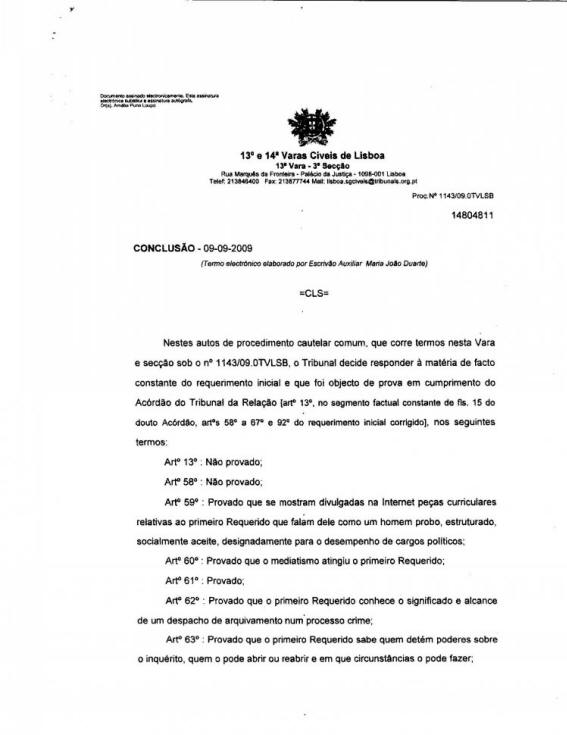 |
| Scan 1_Page_04 |
|
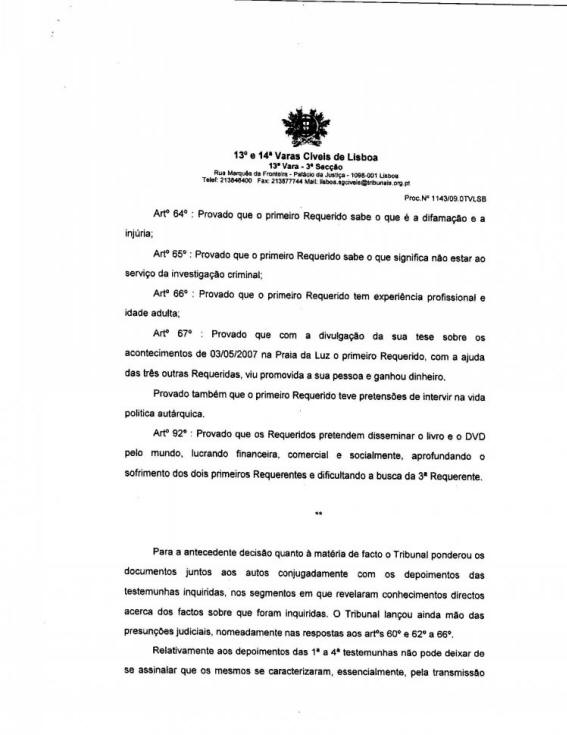 |
| Scan 1_Page_05 |
|
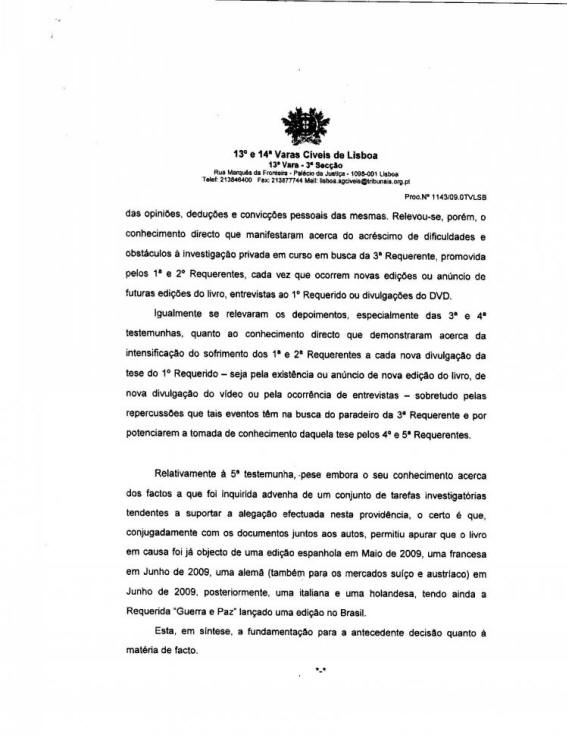 |
| Scan 1_Page_06 |
|
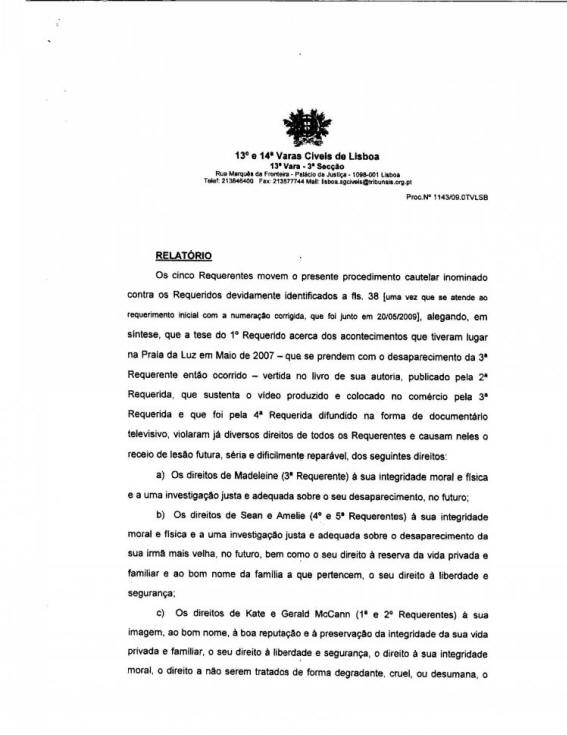 |
| Scan 1_Page_07 |
|
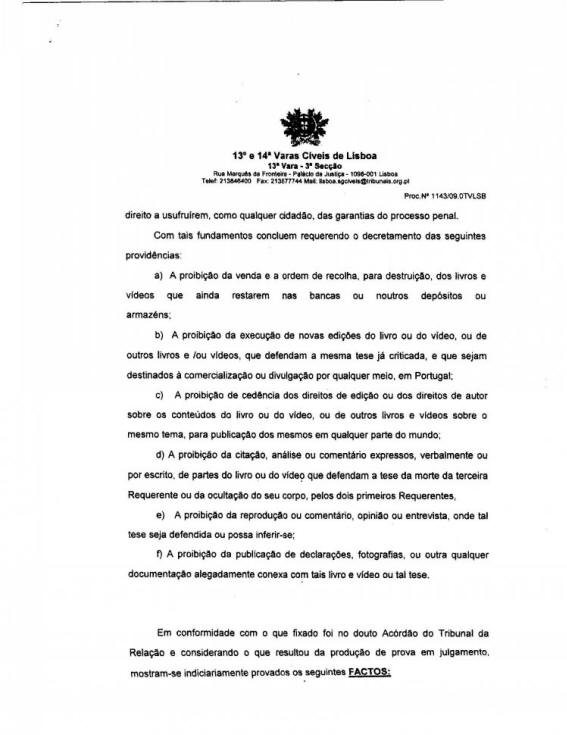 |
| Scan 1_Page_08 |
|
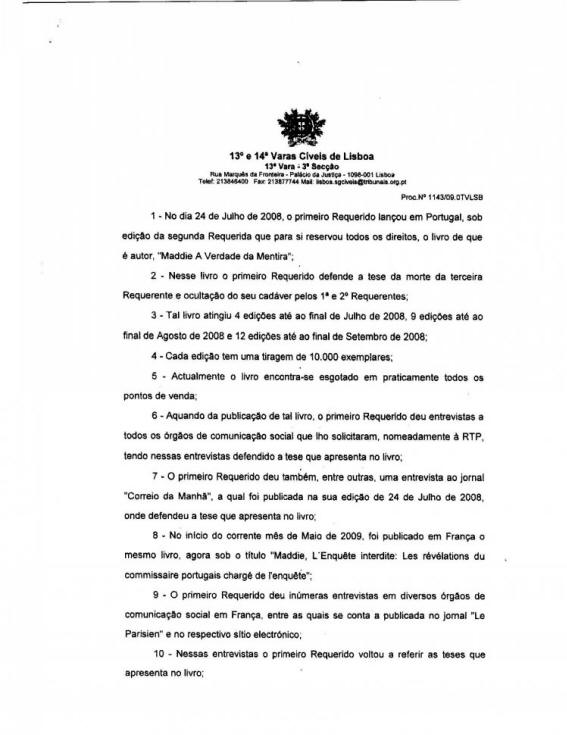 |
| Scan 1_Page_09 |
|
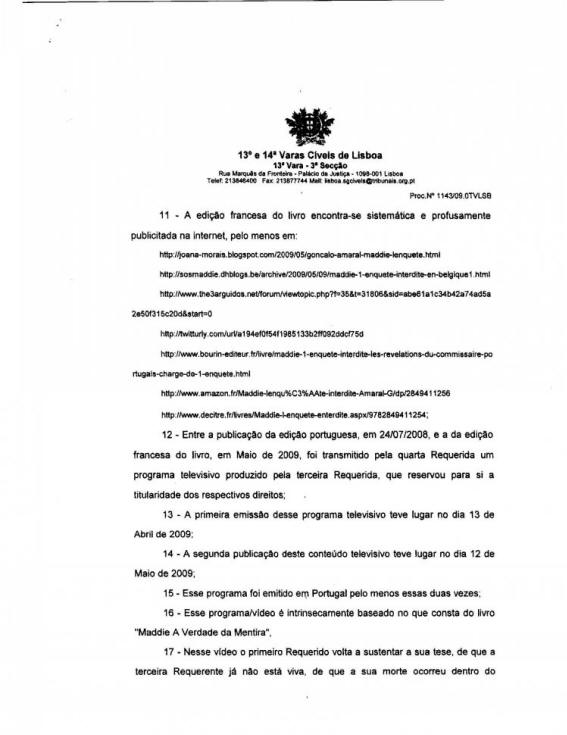 |
| Scan 1_Page_10 |
|
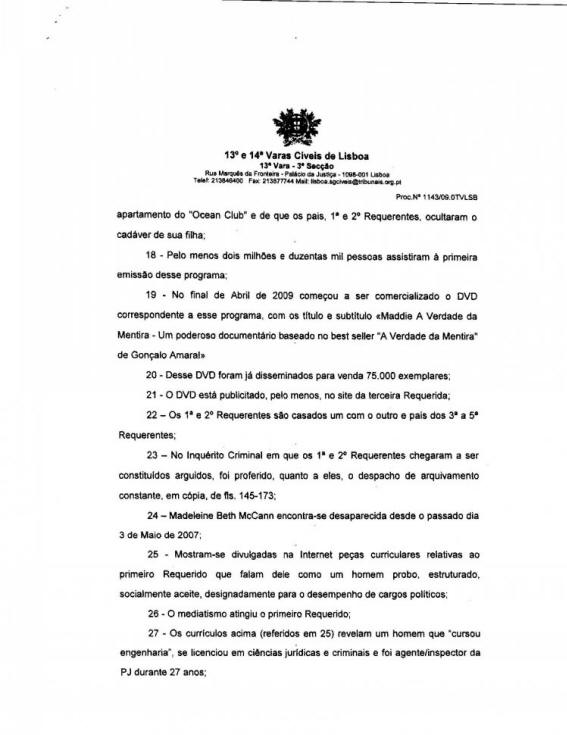 |
| Scan 1_Page_11 |
|
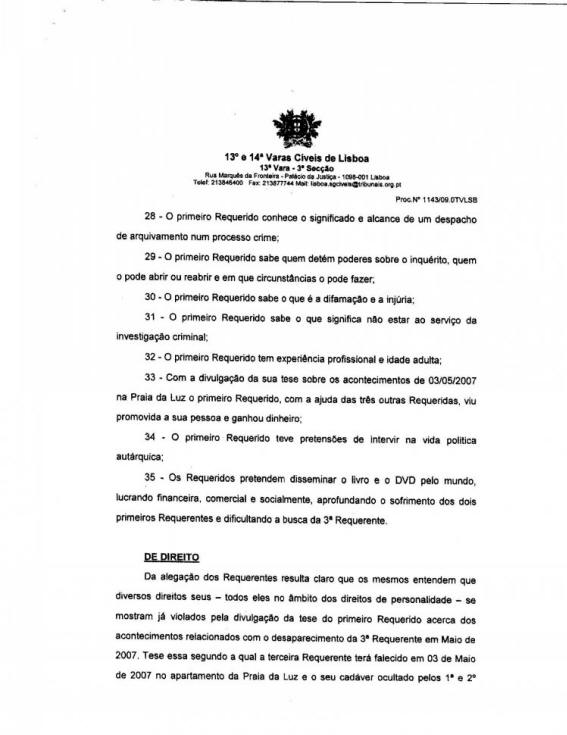 |
| Scan 1_Page_12 |
|
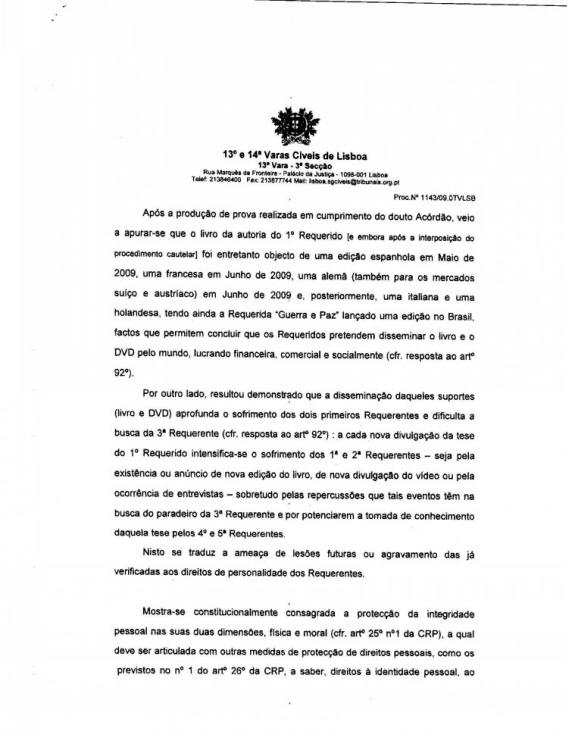 |
| Scan 1_Page_13 |
|
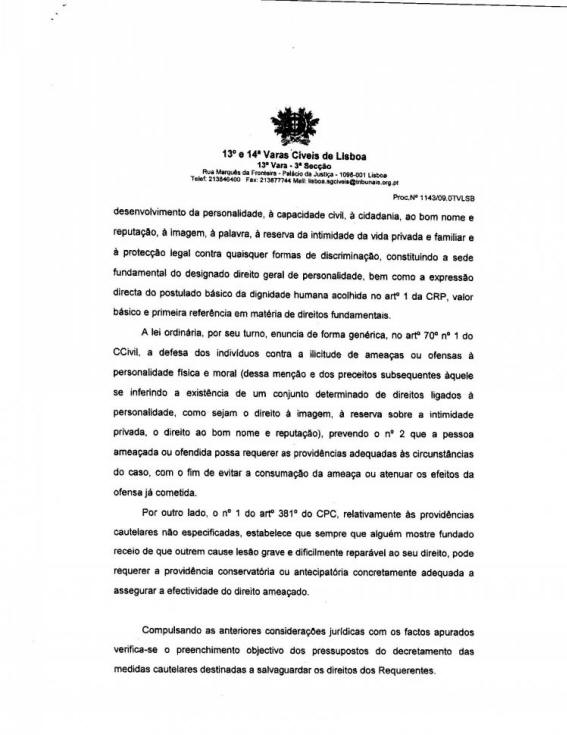 |
| Scan 1_Page_14 |
|
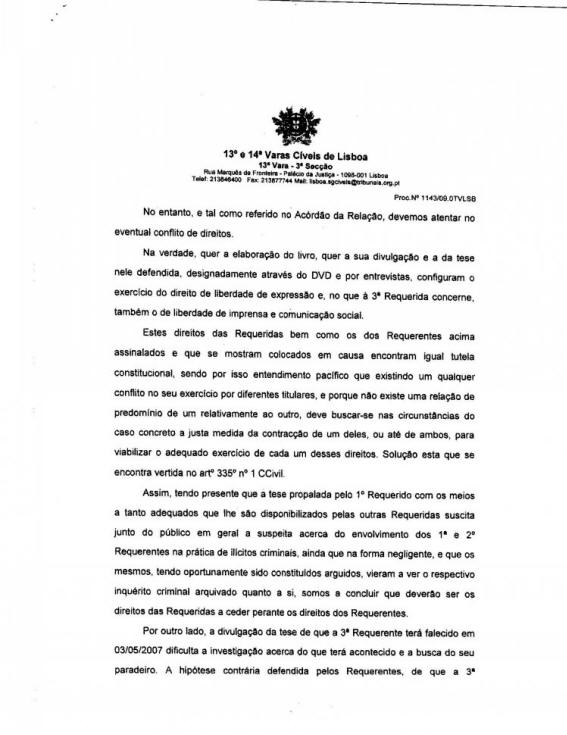 |
| Scan 1_Page_15 |
|
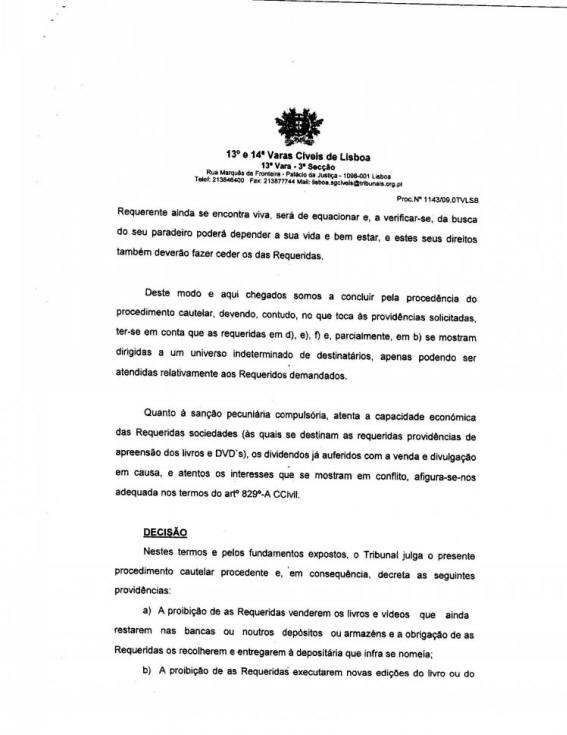 |
| Scan 1_Page_16 |
|
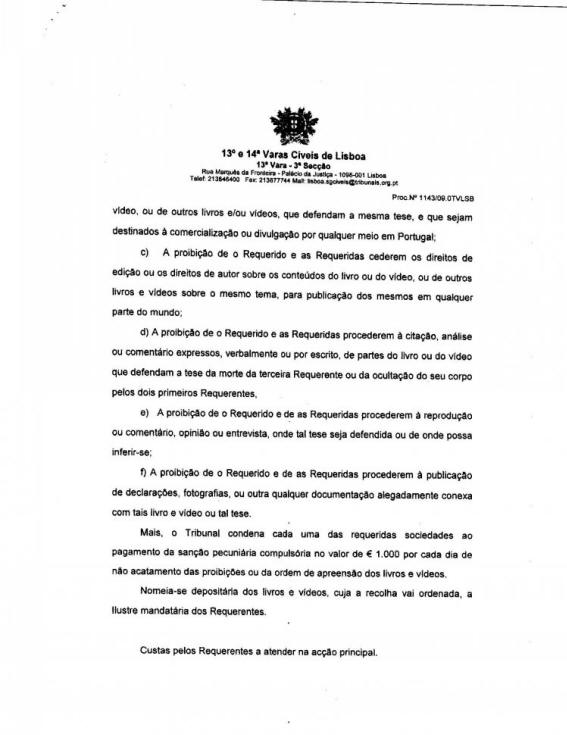 |
| Scan 1_Page_17 |
|
 |
|
|